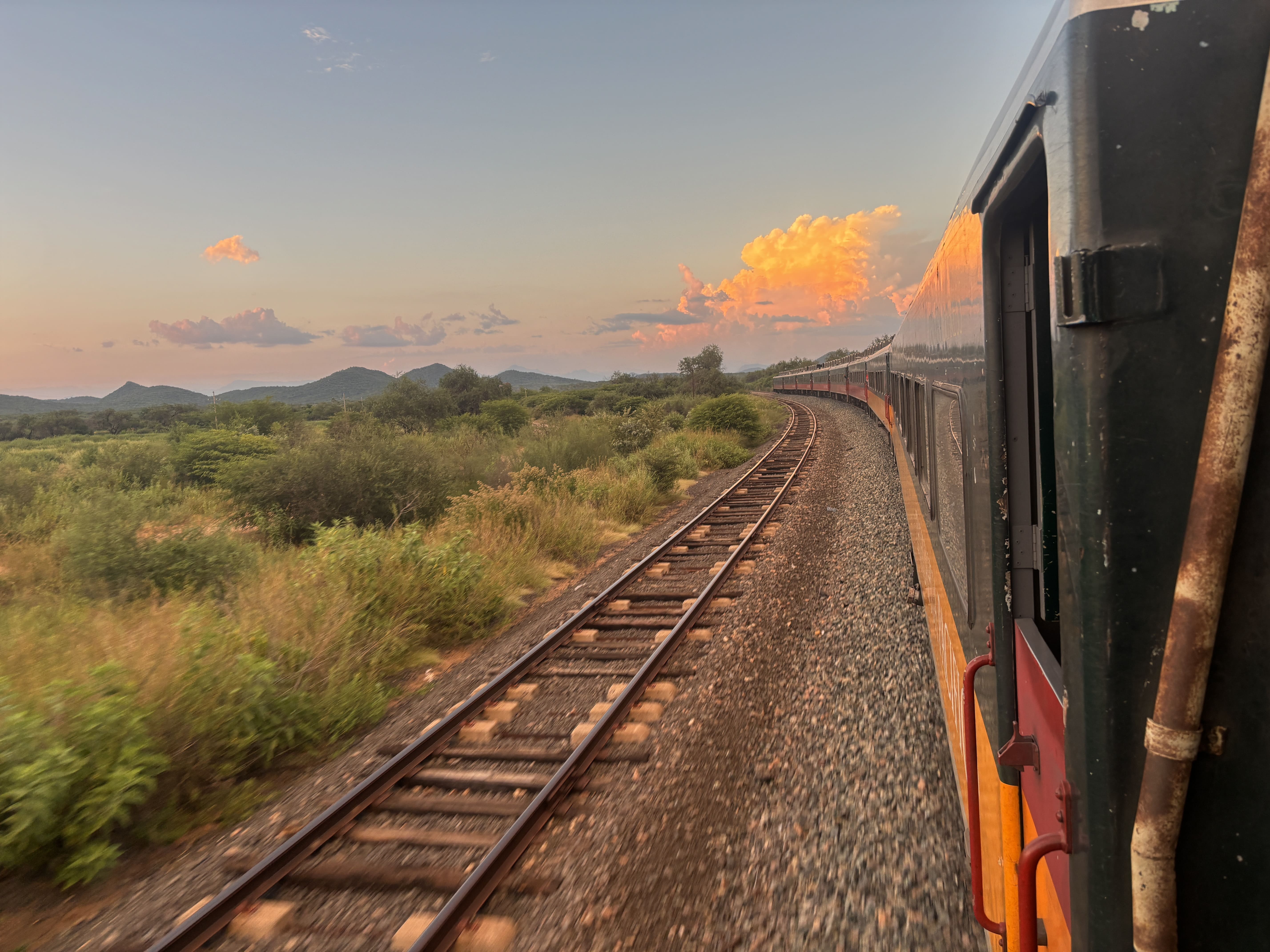
Chepe Regional From Chihuahua to Los Mochis
El Chepe was, until recently, the only passenger train in Mexico, and it remains its most scenic: from end-to-end, the Chihuahua-Pacifico ("Che-Pe") railway covers 668 kilometres over a scheduled 15.5 hours.
Introduction
El Chepe is well-documented online, but most tourists (and most reviews) focus on the shorter, quicker, and far more expensive Chepe Express, which runs only between Creel and Los Mochis. On Tuesdays and Saturdays (eastbound) and Wednesdays and Sundays (westbound), visitors have a cheaper option to see more of this part of Mexico: the Chepe Regional, which keeps going after Creel all the way to Chihuahua, stopping at numerous tiny villages and stations along the way. In September 2026 I rode the full length of the Chepe Regional, across two journeys; this was my experience:
Buying Tickets
This was the most stressful part of the experience but I needn’t have worried. Unlike the Chepe Express, tickets cannot be booked directly online: you must call 800-122-4373, submit an online form (here), or purchase tickets in person. I opted to buy my tickets the day before departure in Chihuahua, which was easy: staff spoke English, and you can buy tickets between any two stations from any station. I took this journey in two parts, and purchased both my Chihuahua-Posada Barrancas and my Posada-Los Mochis tickets at the same time in Chihuahua. This is highly recommended as the Copper Canyon is well worth exploring over a few days, and stopping along the way does not cost any extra.
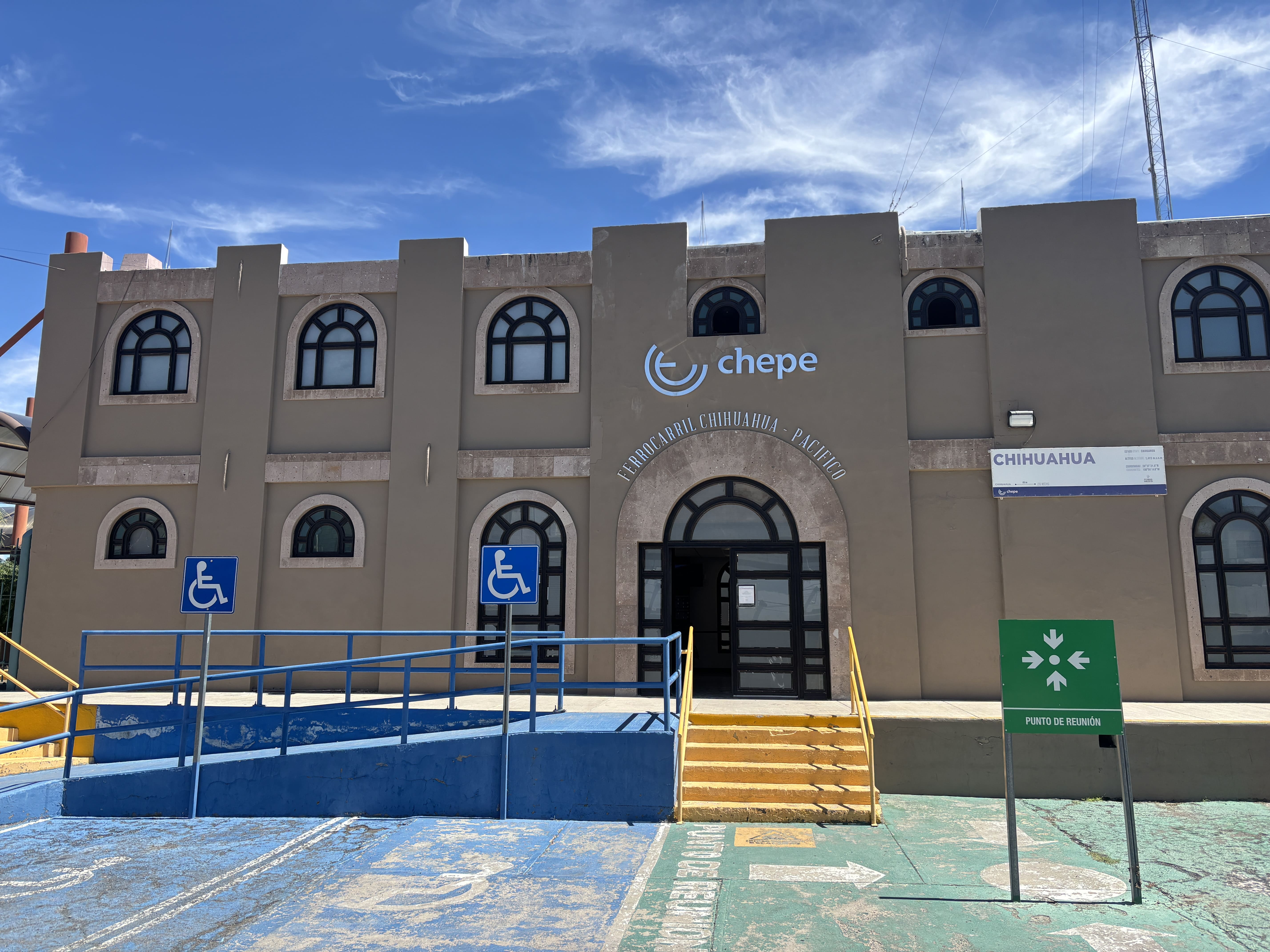
Chihuahua station, in all its...existence.
Note however that there is a minimum fare of $695 MXN, regardless of actual distance travelled: travelling from Divisadero to San Rafael, for example, is only a journey of roughly 20 minutes, but is priced as a journey of 120 km. This means that once you are in the Copper Canyon it is far more affordable to get around by bus, or even taxi.
Previously, purchasing tickets on the Regional train as a foreigner was discouraged: you could only do this with an accompanying ticket on the Express, and only when the Express journey was longer than the Regional. This was another reason why I opted not to purchase my tickets in advance: if this harsh ticketing policy was still in place, I would have taken the bus instead. Thankfully this changed on March 1, 2026: from that date only residents of Chihuahua and Sinaloa states may purchase económica fares. Foreigners and tourists from other Mexican states must purchase turista fares, which are at least twice the price. This dedicated option for tourists on the Chepe Regional has removed the friction that came with buying a ticket that Ferromex really did not want to sell to tourists, as it eats a loss on every subsidised ticket sold. Clearly they would still prefer you pay even more to travel on Chepe Express, but tourists are no longer actively discouraged from travelling on the local service.
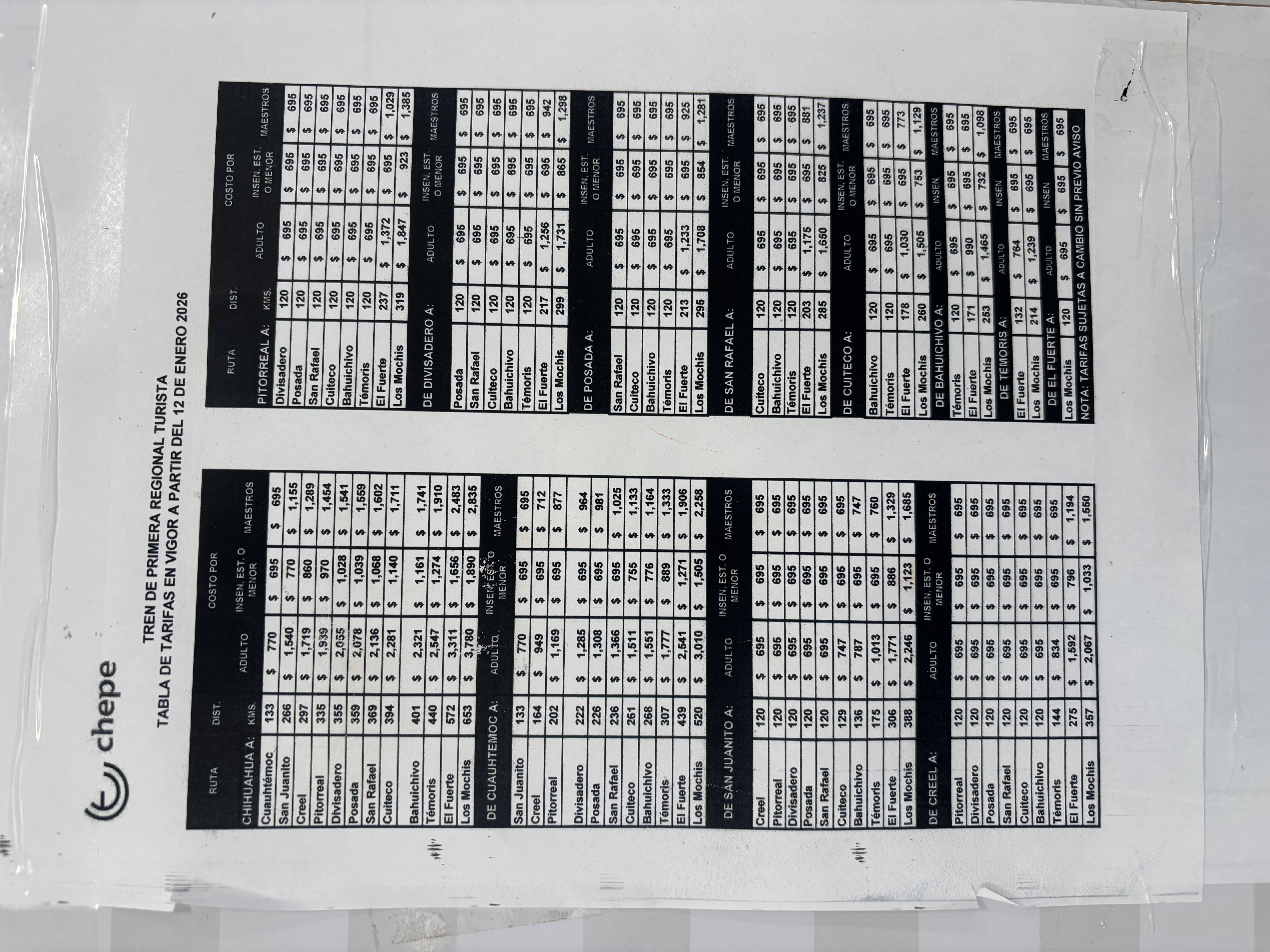
Fares for regional tourist tickets, which all foreigners must purchase.
The official Chepe website does still say that tourists must take the Express between stations where it is available. That doesn’t seem to be enforced any longer, but if you do run into this issue it is easy enough to get around: instead of Divisadero, which is the main gateway to the Copper Canyon, get off one stop later at Posada Barrancas. This is only served by the Regional, and is also closer to most hotels. I was the only passenger who got on or off at this stop, which was also neat…the train barely came to a stop before I was left alone on the platform. You don’t get that in Divisadero.
Despite paying double what a local resident pays, travelling on Chepe Regional is still roughly 1,000 pesos cheaper than the Express between Creel and Los Mochis, in its cheapest ticket category—which has identical seats as the Regional carriages. You get nothing for your added money though: as of January 13, 2025 no fares on Chepe Regional include any sort of food or drink, and all seats across all carriages are identical (other than some carriages in both classes having seatback pockets, and some not). Tourist carriages do come with assigned seats, but once on board most people, myself included, spread ourselves out in any open seats…making this “perk” more of an inconvenience.
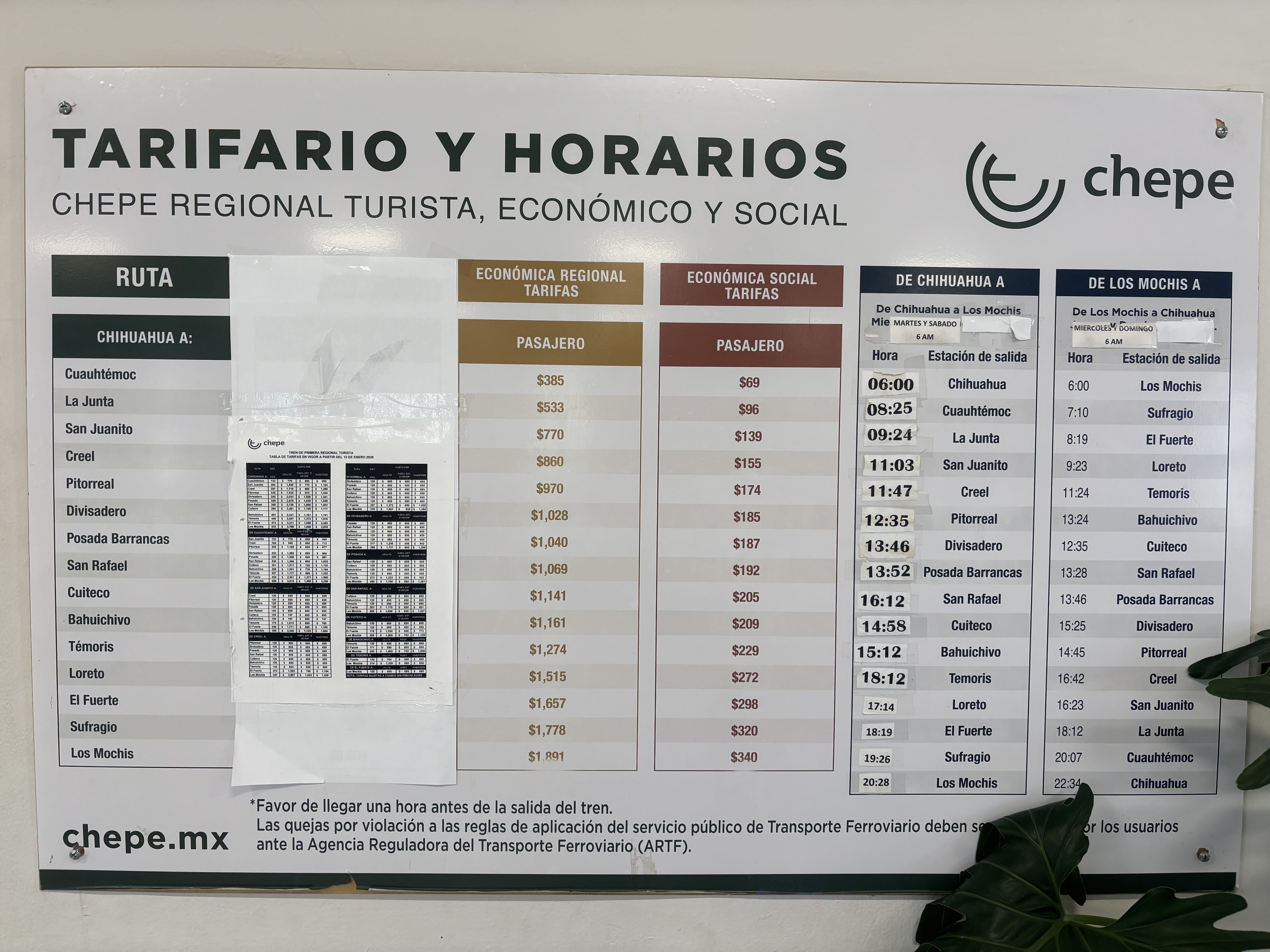
The low local fares subsidised by your inflated ticket price.
On that note, I had no difficulty whatsoever purchasing a ticket less than 24 hours before departure. You can also buy tickets the morning of departure: Chihuahua station opens at 05:00 for an 06:00 service. But the price is identical, and you take the risk of the train selling out. If you do find yourself unable to purchase a ticket, there is also a daily 06:45 bus with Noroeste (not to be confused with the larger Noreste) from Chihuahua to Divisadero.
Departure from Chihuahua
I arrived at Chihuahua station around 05:20, which was too early. Finding a Didi or Uber at that hour wasn’t an issue, and the drive from the city centre is at most ten minutes. Unfortunately the city’s bus network doesn’t operate that early, but the rideshare was only the equivalent of around $2.50 USD.
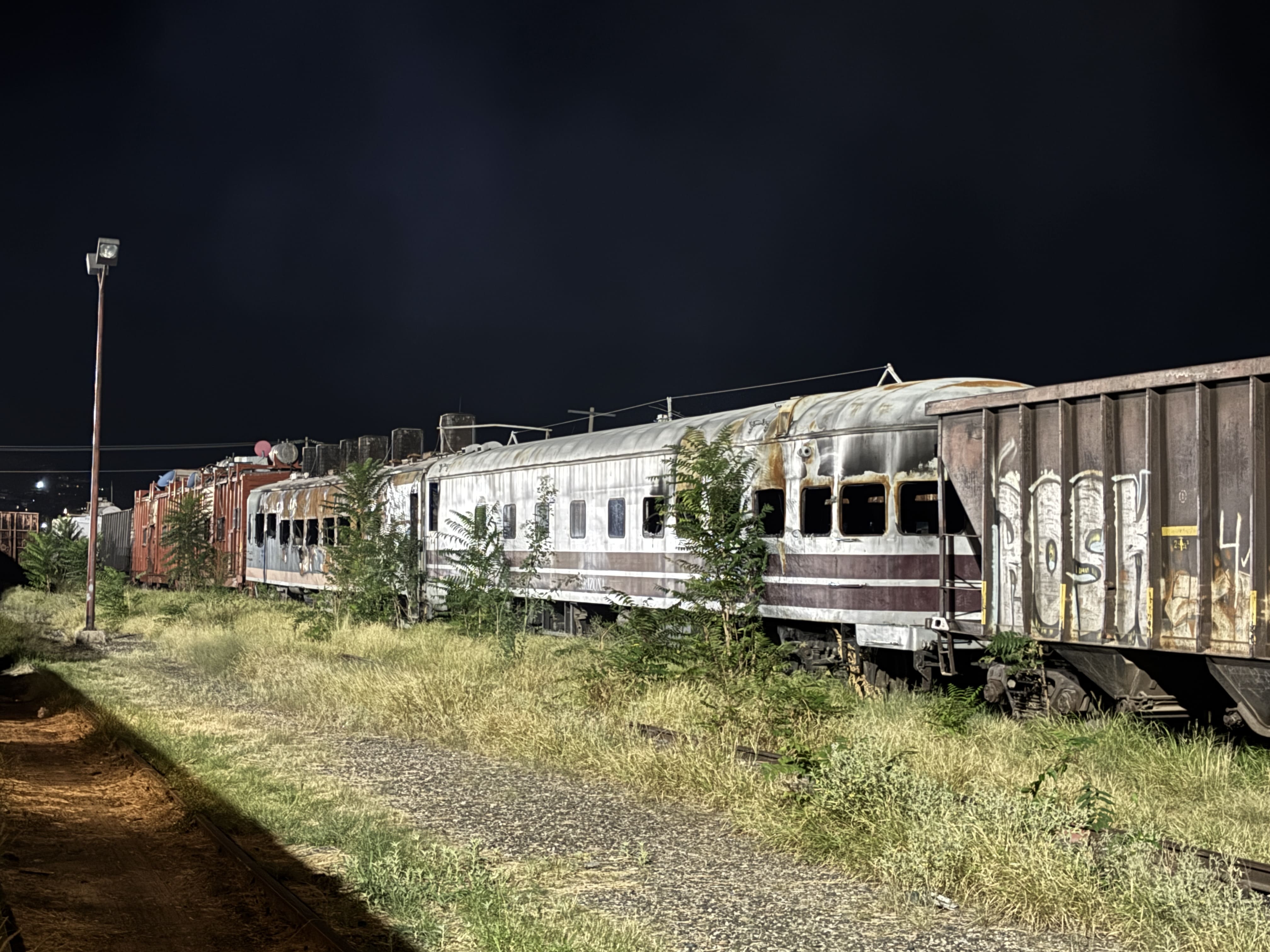
Thankfully not our train.
There was already a lengthy queue when I arrived. If you already have your ticket, join this line; if not, walk into the station where there will be another, hopefully shorter line leading to the ticket window. The station has free toilets. Surprisingly there were no vendors outside the station, so purchase whatever you want to bring with you in advance.
There are no vendors at Chihuahua station, or indeed at any station en route other than Divisadero. Buy everything you need in advance.
Boarding started at 05:30 and moved quickly. My train had ten carriages: three turista class, one refreshment car, and six económica wagons (which in turn were split between full-fare and heavily-subsidised social fare). Turista carriages are directly behind the locomotive, which can get quite loud as the train blows its horn frequently through populated areas. I was in car one on both of my trips, and on both trips one of the three tourist-class cars was reserved for a dozen or so staff. It was a very light load.
We left three minutes late, at 06:03.
On Board
Odd-numbered seats are windows. While you definitely want a window seat, it doesn’t make much difference on which side you sit: the train zigs and zags its way up and down cliffsides, so your view will alternate between stunning vistas and a sweeping view of…rock. Leaving Chihuahua, you do get a lovely view of the sunrise sitting on the left.
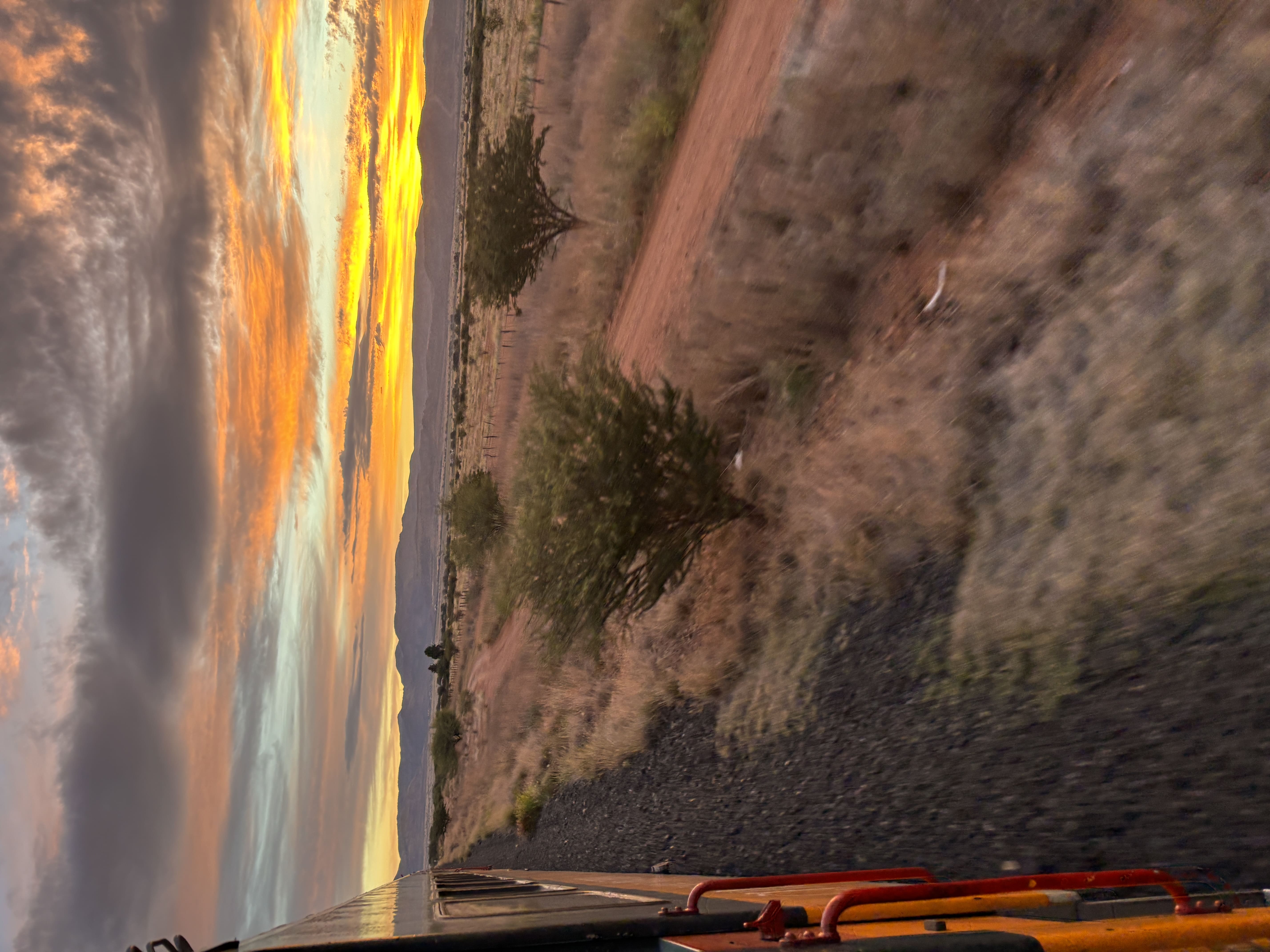
You'll get a stunning sunrise view on the left leaving Chihuahua.
On that note: unlike the Express, the Regional both begins and ends its journey in darkness. The bright interior lights mean you can’t see much outside before sunrise and after sunset. This was only around half an hour leaving Chihuahua, but was about 2.5 hours of darkness before reaching Los Mochis.
Seats are arranged 2-2 across all classes, and indeed there is no difference whatsoever in seats: all were pretty stained and dirty. Each car has two toilets, though across both my trips I never found one that had all four of toilet paper, soap, hand towels, and water…so take a quick glance before committing to any sort of movement. A green light above the door shows when the toilet is vacant, though quite a few were out of service so you may need to walk between cars. Carriages, including washrooms, were kept reasonably clean throughout the journey.
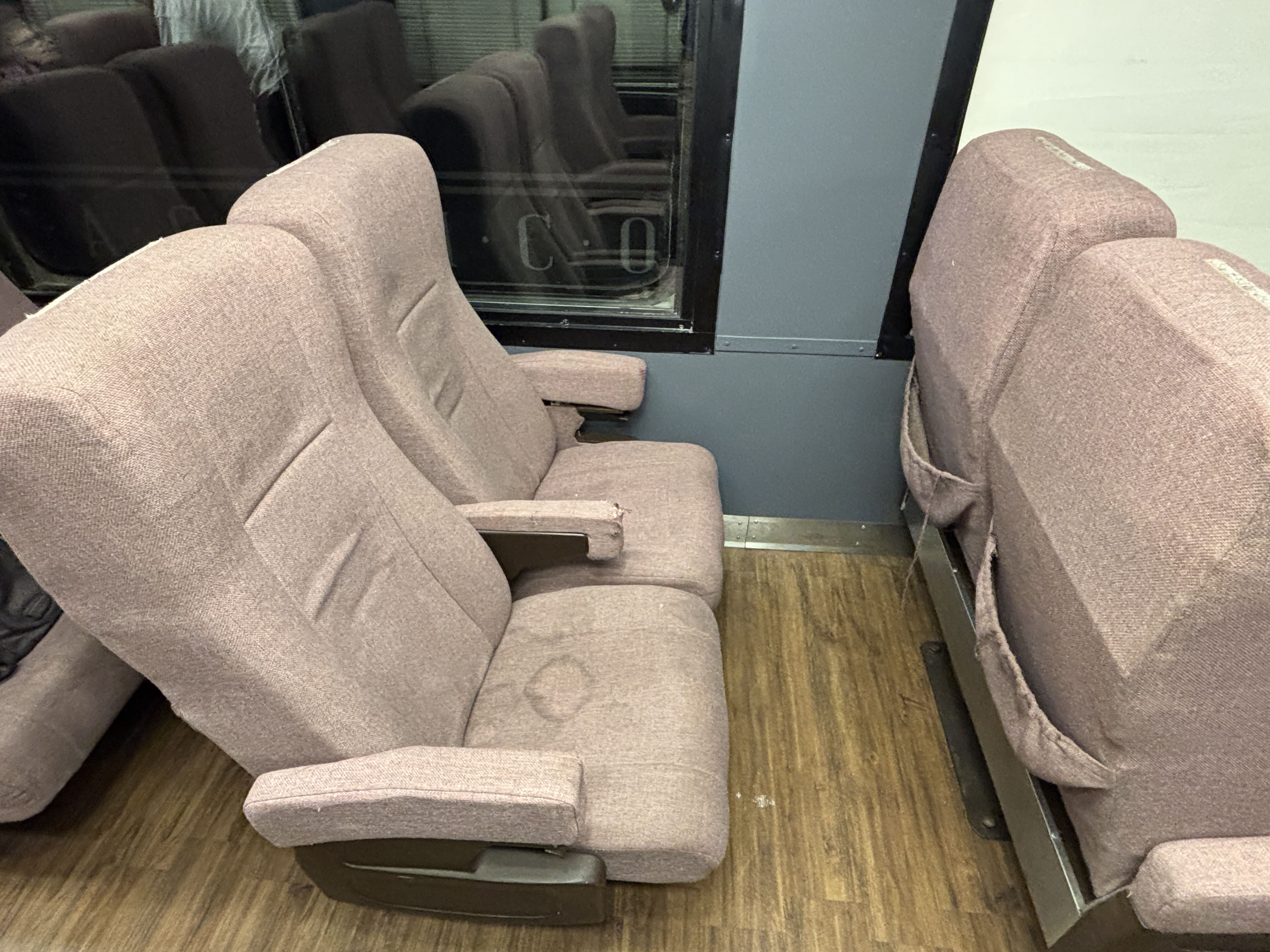
It ain't pretty. It ain't particularly comfortable after eight hours either.
Each car has an attendant, which added to an overall feeling of security: carriages also have security cameras (whether or not these work I can’t say…but neither could an opportunistic thief), and the train has armed security. At no point did I feel uneasy about leaving my belongings at my seat.
Overhead racks take smaller bags, up to a rollaboard carry-on. Any checked bags would go in dedicated areas at the front of each car.
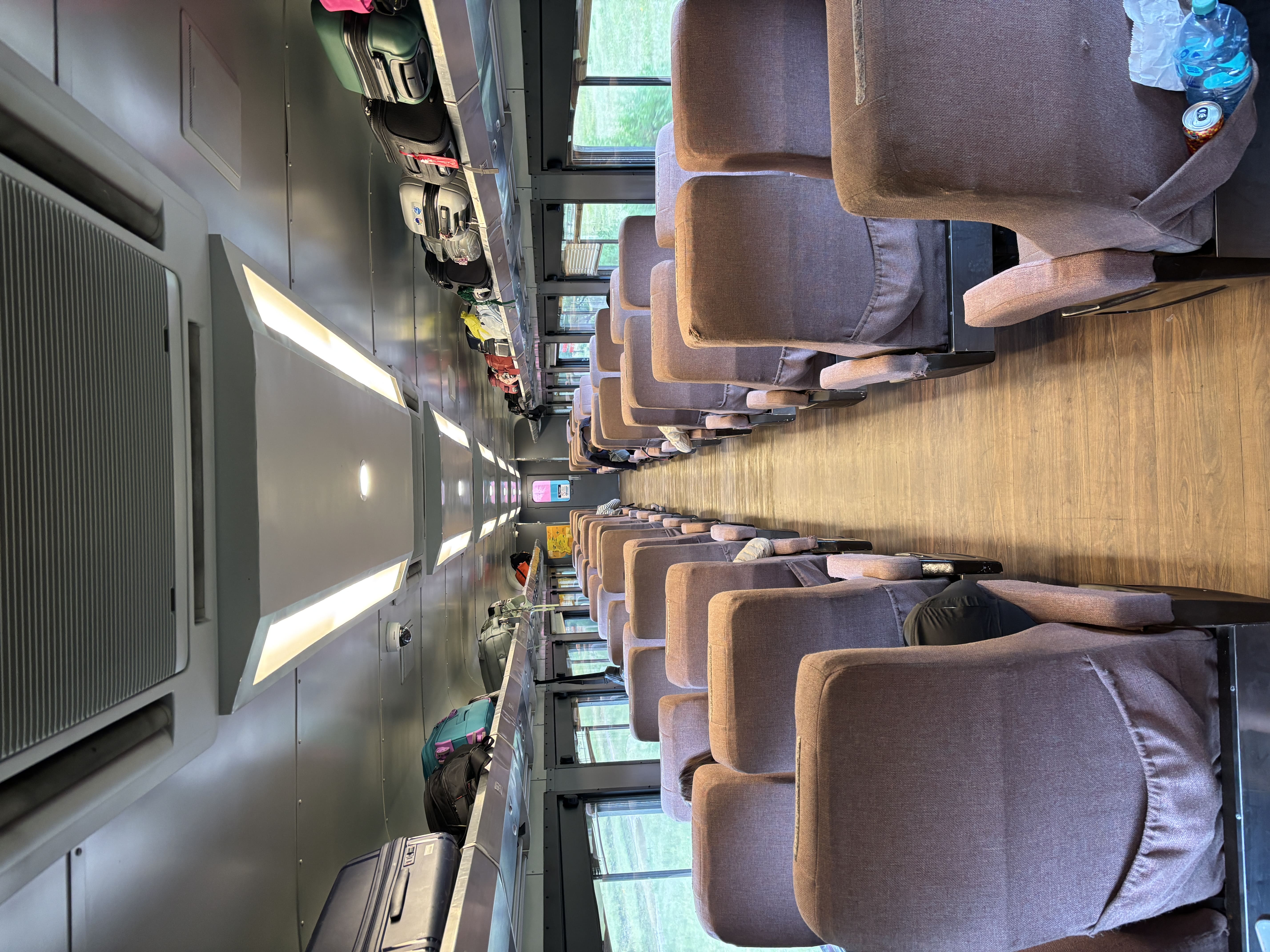
Three tourist-class carriages made the trip, all mostly empty.
Seats have generous legroom, around 36 inches, and also recline about five degrees. There is quite a lot of padding, which was comfortable on joints but, even with strong air conditioning, traps a lot of body heat which got uncomfortable after a while. There are no amenities at all: no reading light, air vent, table, or charging options. There is also no WiFi, and cell service is sporadic along the route.
The main attraction is outside. Blinds can be raised or lowered using a knob next to each seat pair; this is quite a good solution actually, since lowering the blinds blocks 75% of the sunlight while still letting you see 75% of the scenery. Windows were relatively clean: not spotless, but you could clearly see what was outside.
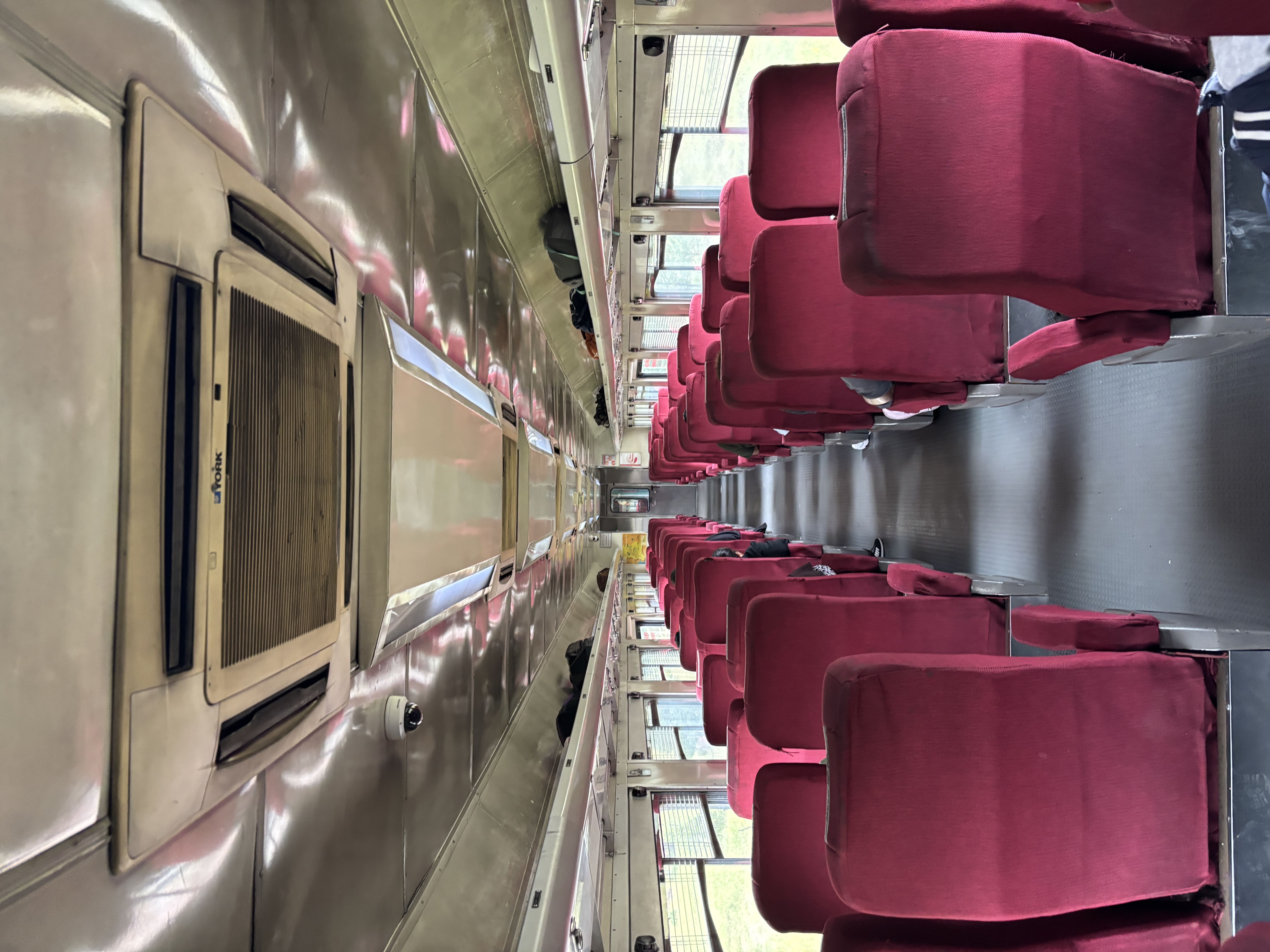
Económica-class carriage. Can you spot the difference? Neither can I.
For the best photos and views though, head to the vestibule between carriages. This is a huge improvement over the Express, which is geared towards safety-obsessed tourists: on the Regional train, the top half of the bifurcated door is left open. There are signs saying not to stand there, but these are ignored (as are the no-smoking signs). Leaning outside as the train slowly wound its way through the Copper Canyon, watching the scenery unfold, and feeling the cool air of Divisadero give way to the brutal heat of Sinaloa…no bus ride can compete with that. I spent hours of the trip here, and not once did I wish I had paid five times as much for an enclosed viewing car.
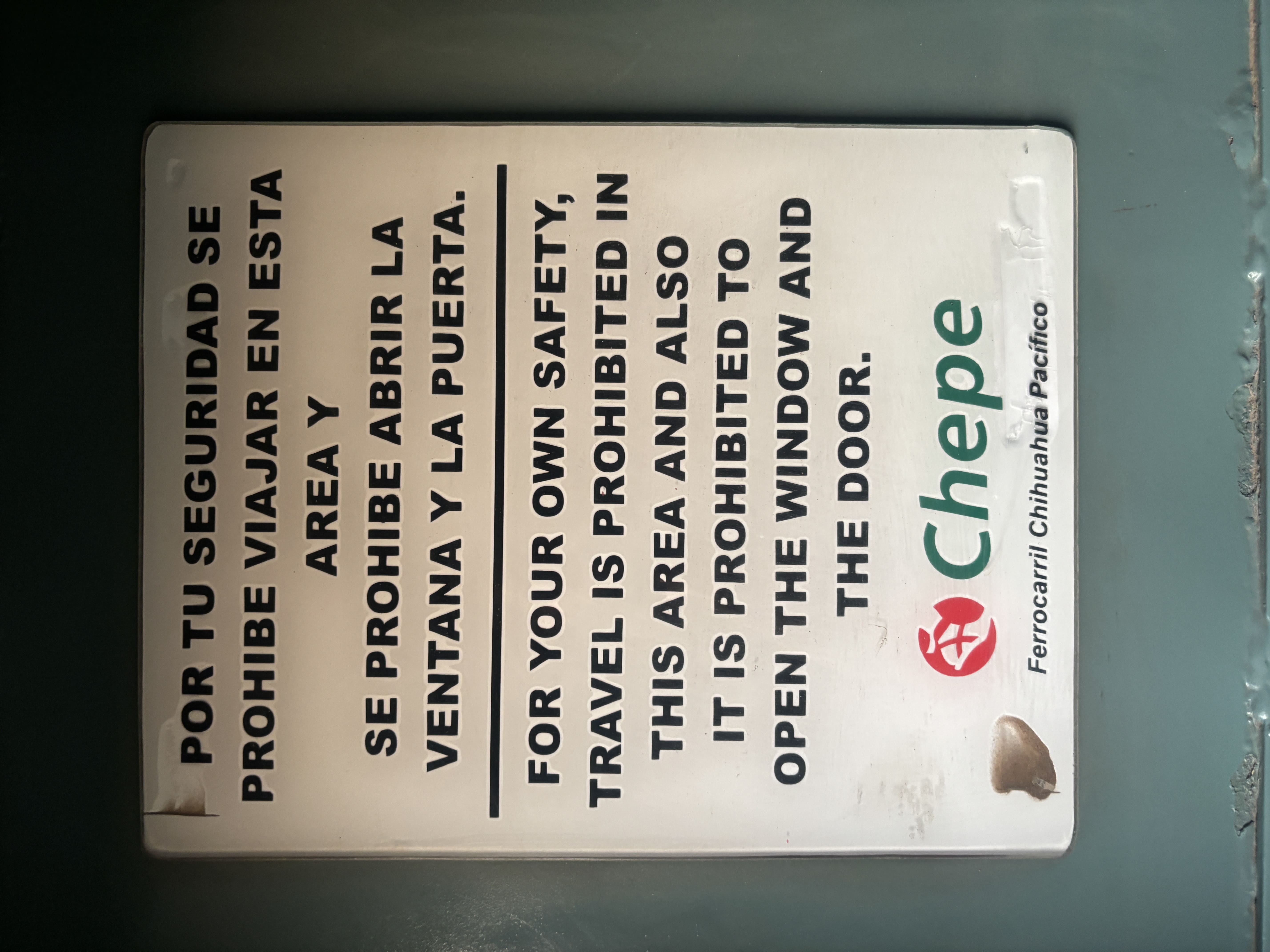
You can ignore this.
While the route is kept clear of debris, there are frequent trees that get within a few inches of the train. Pay attention, and if you are going to lean out do so facing forward.
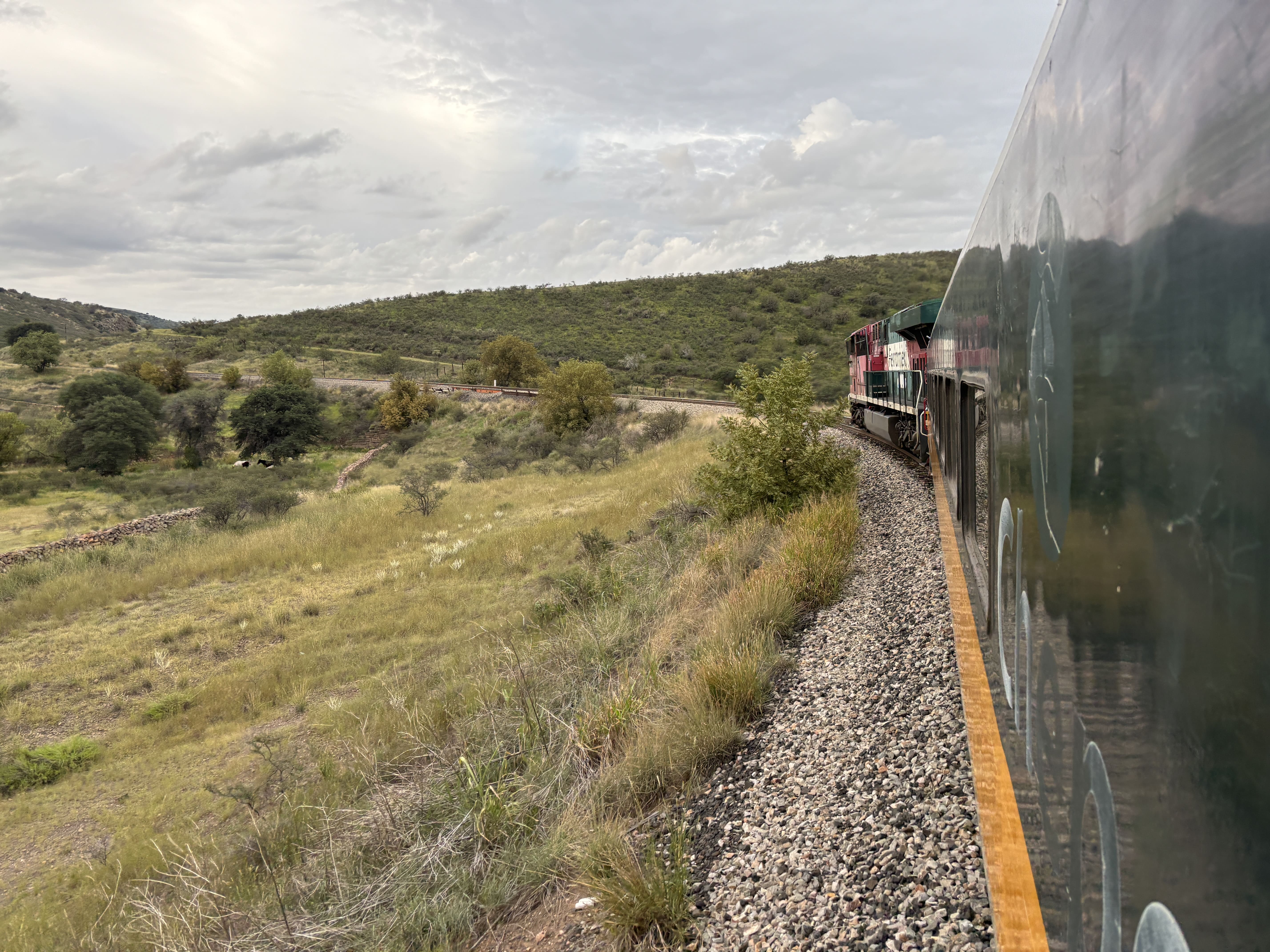
Don't be scared: head to the vestibule for fresh air (other than the occasional whiff of cigarette smoke) and the best views.
Unfortunately there is only one fresh air break across the entire trip: for 15 minutes at Divisadero, which is just enough time to walk down to the viewpoint (2-4 minutes, depending on your carriage), take some photos, buy a souvenir or some food, and walk back. At all other stops passengers must remain on board, which is rather annoying: the train sounds its horn when it is ready to depart, any passengers who miss that deserve to be left behind.
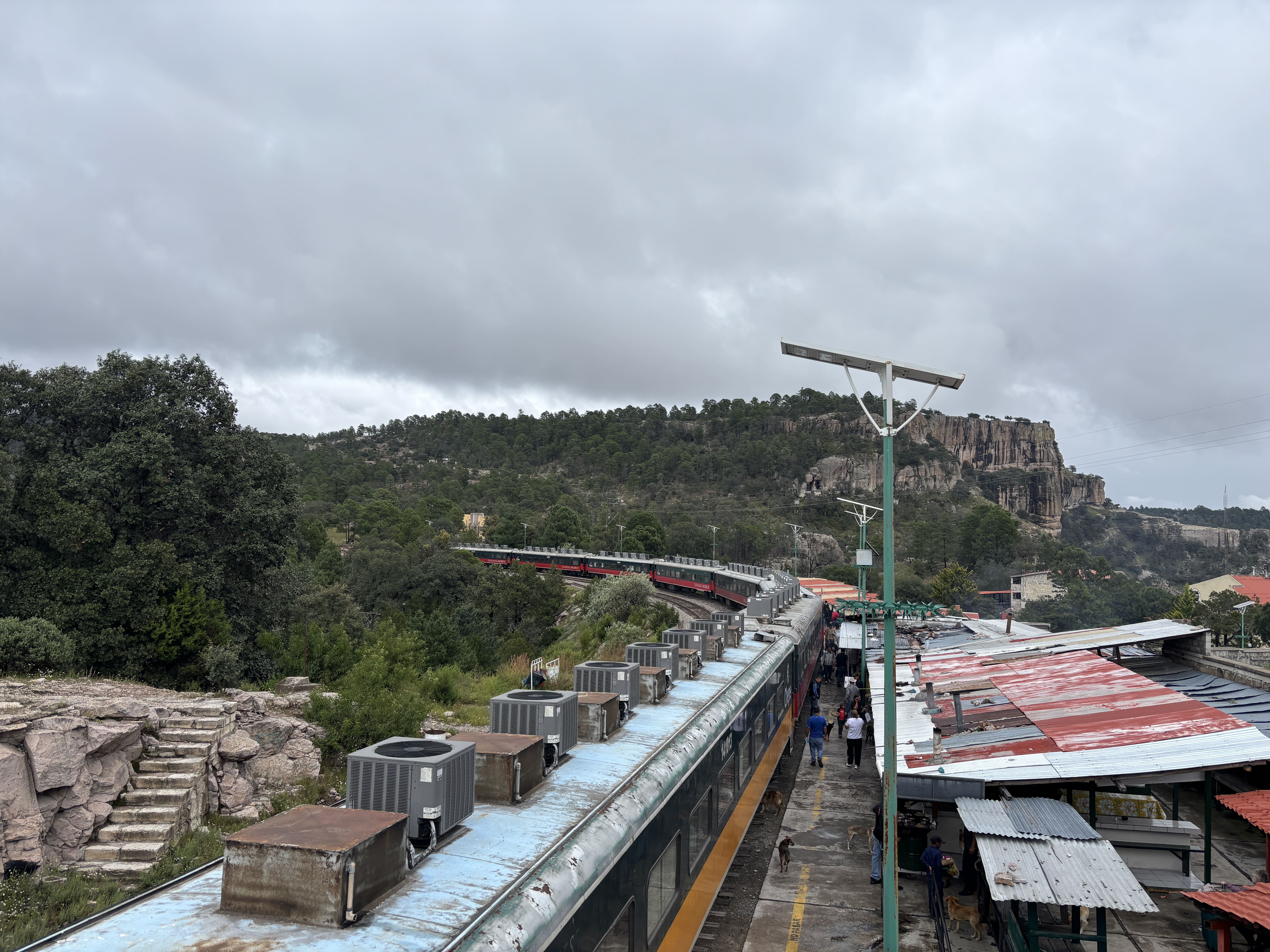
You'll have 15 minutes at Divisadero, regardless of whether or not the train is on schedule.
My first journey, from Chihuahua to Posada Barrancas, was reasonably on-time. The second trip, from Posada to Los Mochis, was 20 minutes late. Despite being on board for roughly eight hours each trip, and despite the early start from Chihuahua, I was still feeling fresh at the end of both journeys: getting plenty of fresh air in the vestibule helped, as did bringing a litre of water with me on board each time.
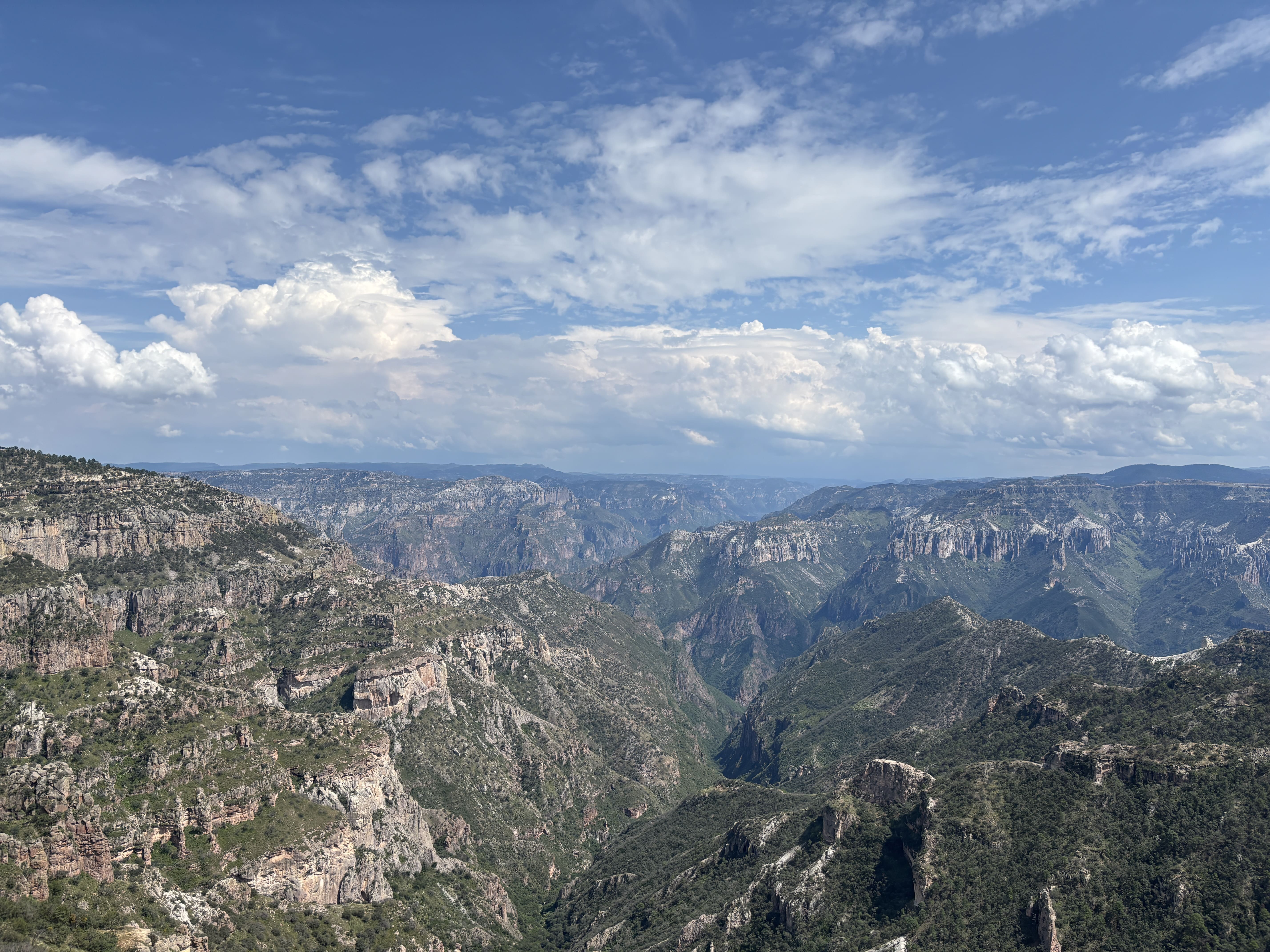
A short walk down from Divisadero station leads to this view.
Food
It’s not good. Snack and drink options are limited and over-priced: you can and should bring food with you on board. You’re welcome to bring anything other than alcohol. You can also buy food during the break at Divisadero: vendors are well prepared for the train’s arrival, and have hot food ready to go. A gordita with beans, cheese, and meat costs 50 pesos, which is about what you would expect to pay elsewhere in Mexico. There are also two small convenience stores: one at the bottom of the staircase leading to the viewpoint and the other at the top of a staircase leading away from the platform. Here you can get cold drinks for roughly half the price as on board, though still about 50% more than you would pay elsewhere.
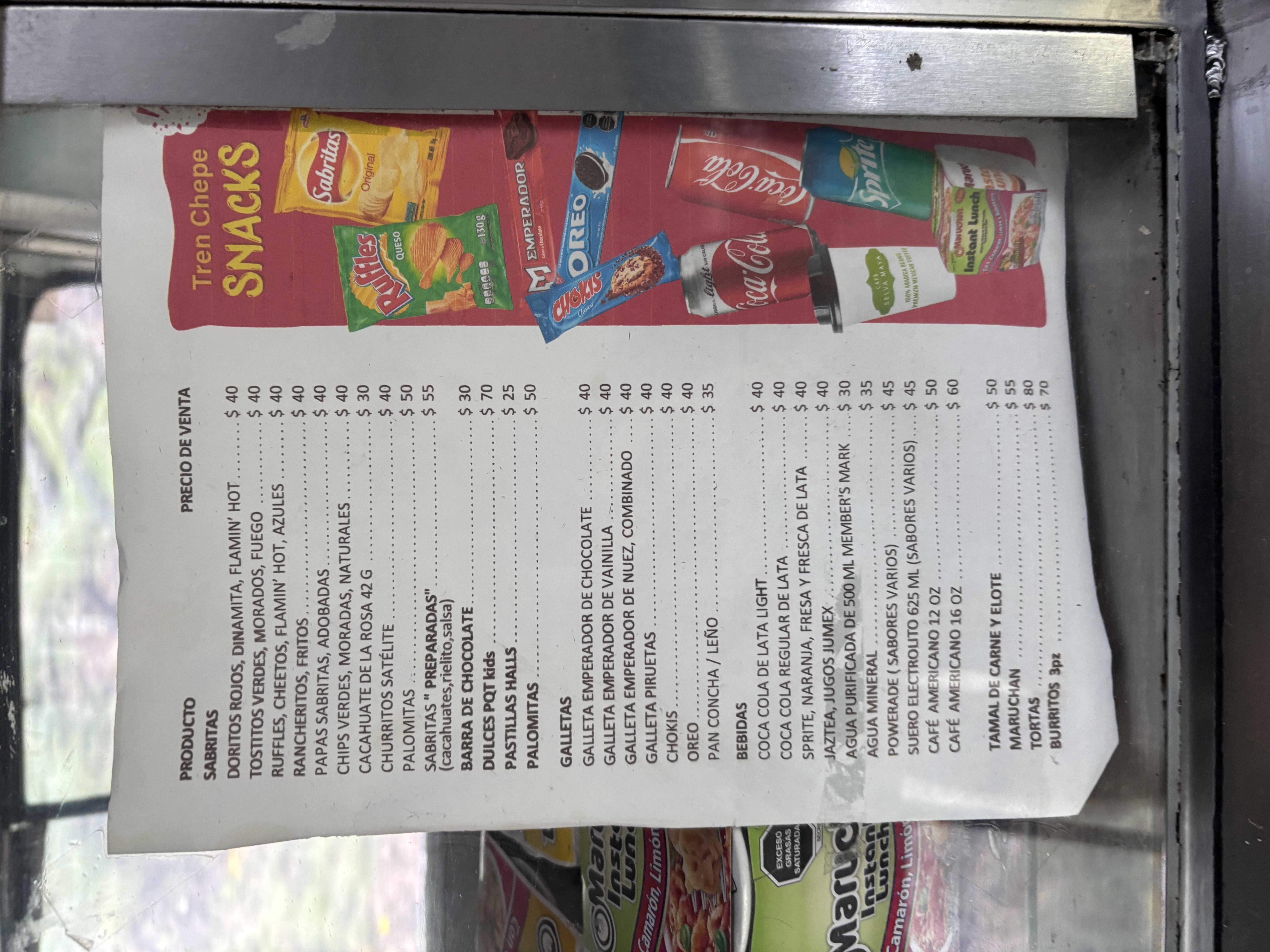
Nothing looked good, and everything was priced for a captive audience.
If you do choose to buy food on board, hot options sell out quickly so plan to eat early. A trolley also passes through the train somewhat regularly, selling snacks and drinks. The only “meal” available from this trolley was instant noodles.
Breaking up the Journey
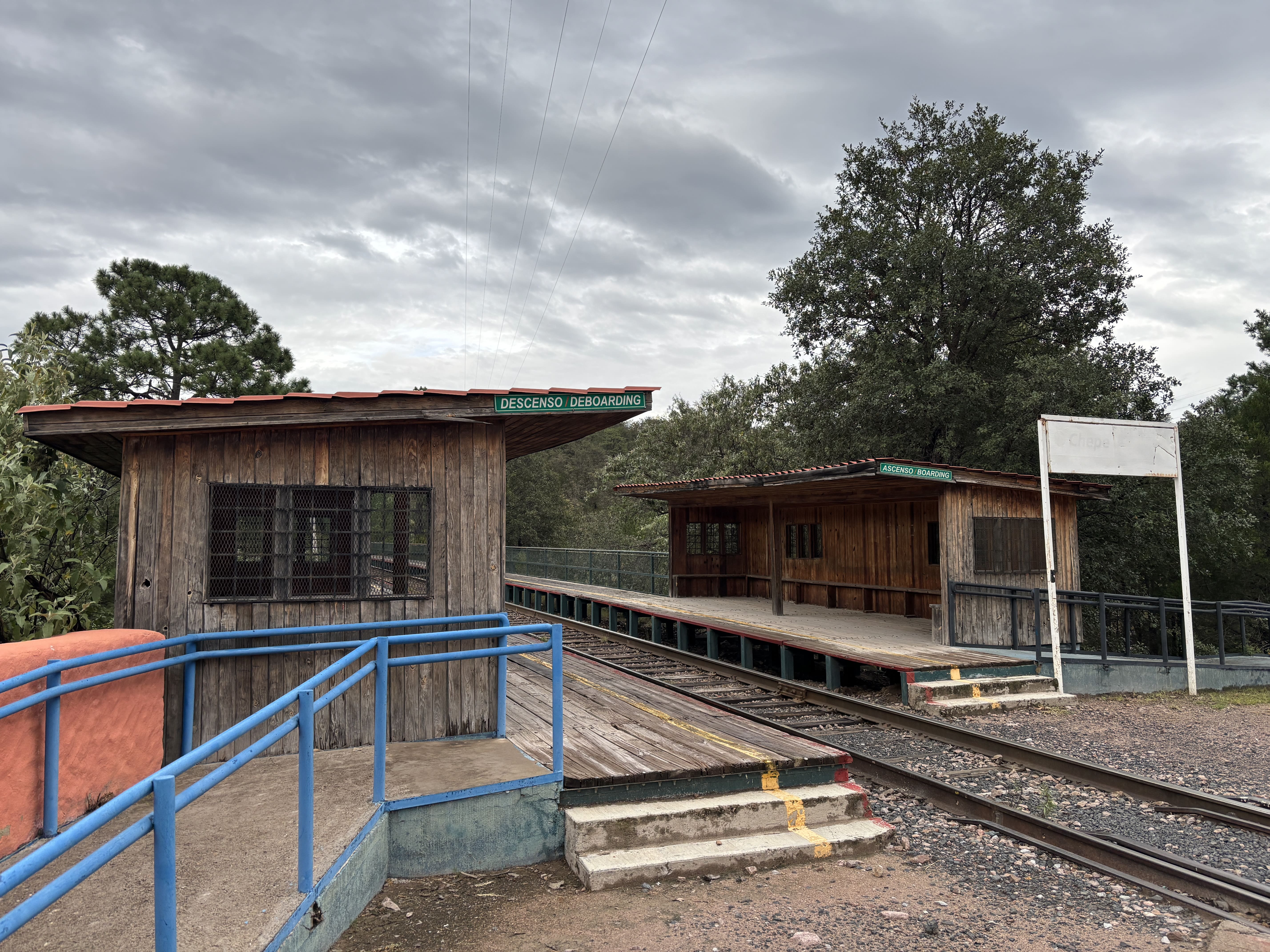
Posada Barrancas station is an immediate reminder that you have arrived in a quieter part of México.
While you can book a single ticket all the way from Chihuahua to Los Mochis, this would be an exhausting ordeal. I opted to break this up into two chunks, stopping halfway at Posada Barrancas station (located in the town of Areponapuchi). I travelled in the off season, and noticed this as soon as I went for a walk around town: nearly everything was closed, but I was still able to find somewhere to eat for each of my four days there.
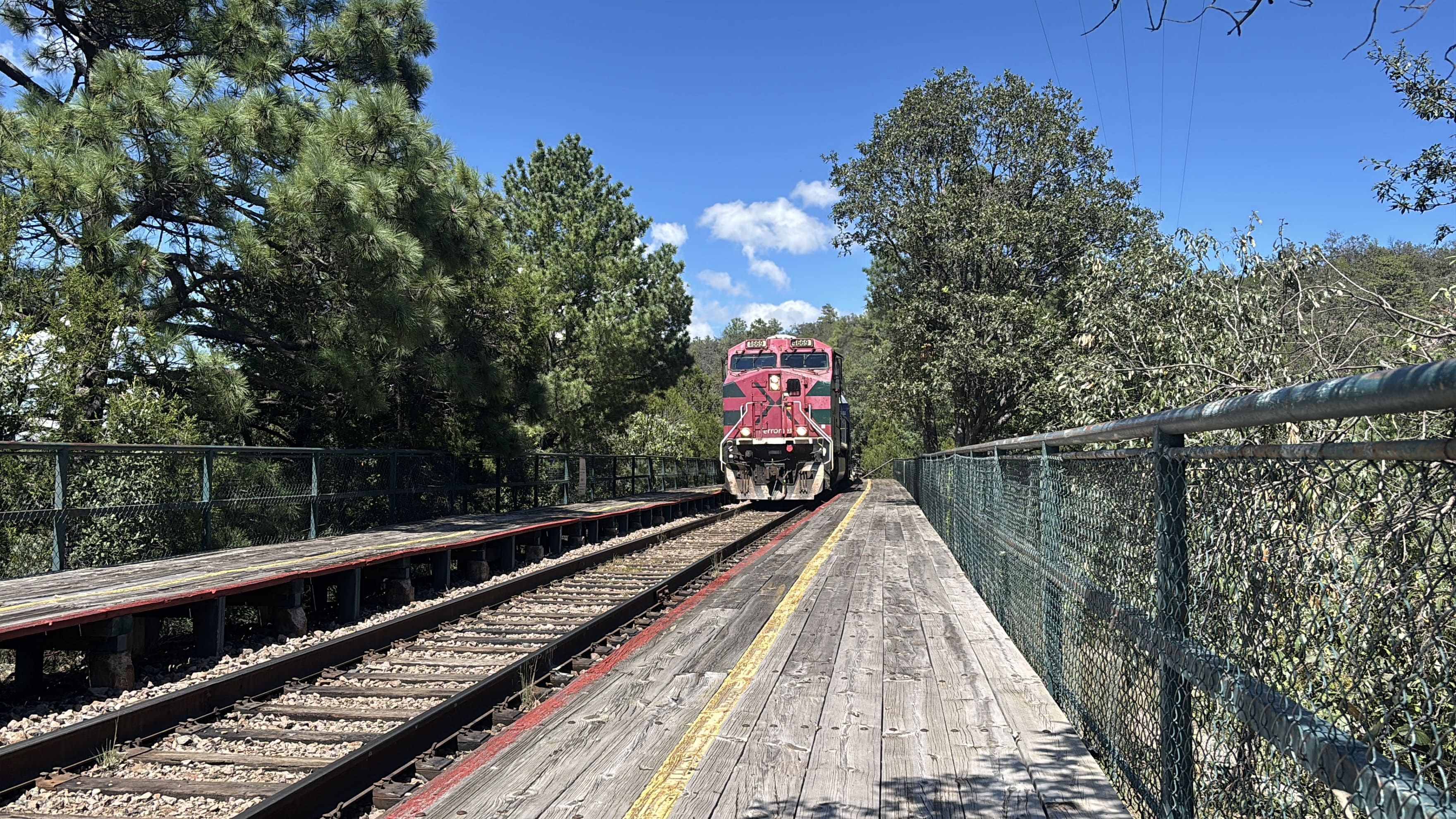
I was the only one who got off, then the only one who got on at Posada Barrancas. Doing my part to pad the annual ridership figures.
What do you do in the Copper Canyon? It depends on your travel style and budget. There are organised tours that will take you anywhere you want to go, and every hotel will either offer these directly or be able to arrange them for you. I had four days in Arepo, so opted instead to explore at my own pace. The area is safe, and I went for multiple multi-hour walks with no issues. You can also catch a local bus: from Divisadero to Arepo, for example, was only $20 MXN.
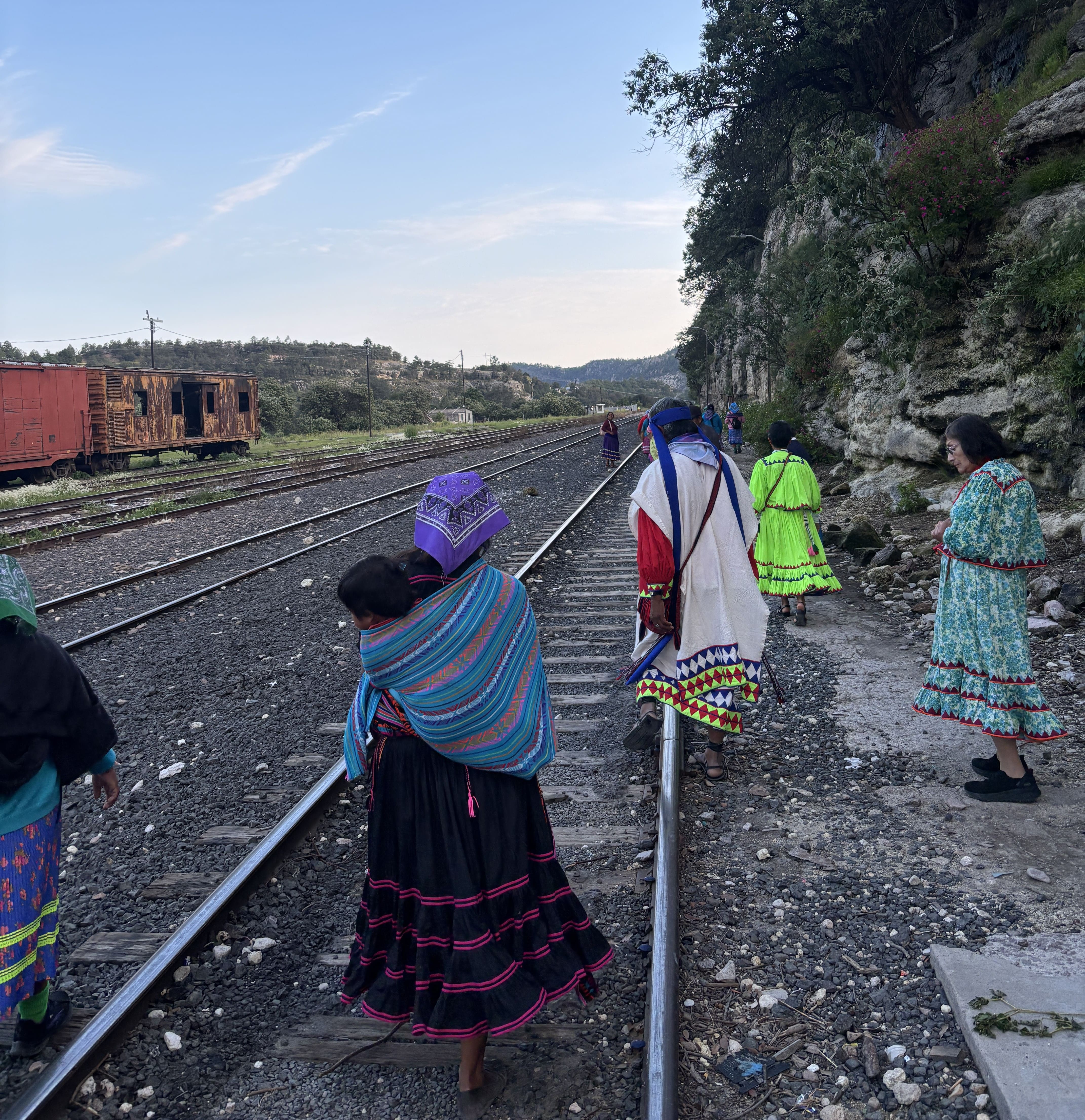
A different perspective of a section of track along which I'd travel in a few days.
The town of San Rafael is well worth a visit. I was extremely fortunate, perhaps as fortunate as I have ever been whilst travelling, to participate in a full day of ceremonies and celebrations with the local Raràmuri people, thanks to two chance encounters with a friendly priest on two consecutive days. This isn’t the sort of thing you can book as a tour…and it’s also the sort of impromptu experience you miss passing by on a train.
Top Tips
- Buy your ticket early: Now that Chepe Regional has separate fares for tourists, there is no advantage to buying at the last minute. The price you pay will be the same.
- Stop off along the way: Sixteen hours is a long time to be sitting or standing with only a single short break. There is no added cost, and you can book all of your tickets at once.
- Board prepared: Bring your own food, plenty of water (at least a litre, I wish I had brought more), and fully charge your devices since you will be taking plenty of photos. You’ll also need something to do before the sun rises and after it goes down: a book, some downloaded podcasts, etc.
- Visit the vestibule: Aside from the fresh air being a welcome break from the inside of a train carriage, you get unsurpassed views with no glass in the way.
Cost and Final Thoughts
I paid $2,072 MXN for my ticket from Chihuahua to Posada Barrancas, then $1,708 from Posada to Los Mochis. Total: $3,780, identical to buying a single ticket all the way. You can pay by card for no added cost. This isn’t cheap: $308.93 CDN, about $220 USD. But it is cheaper than the Express, and while significantly more than travelling by bus, the scenery is absolutely worth it. If you’re on a budget, the best views are between Creel and El Fuerte: as of late 2026 this trip would cost $1,592 MXN. You can travel to and from these two cities by bus for much less than taking El Chepe, and not miss much in the way of scenery.
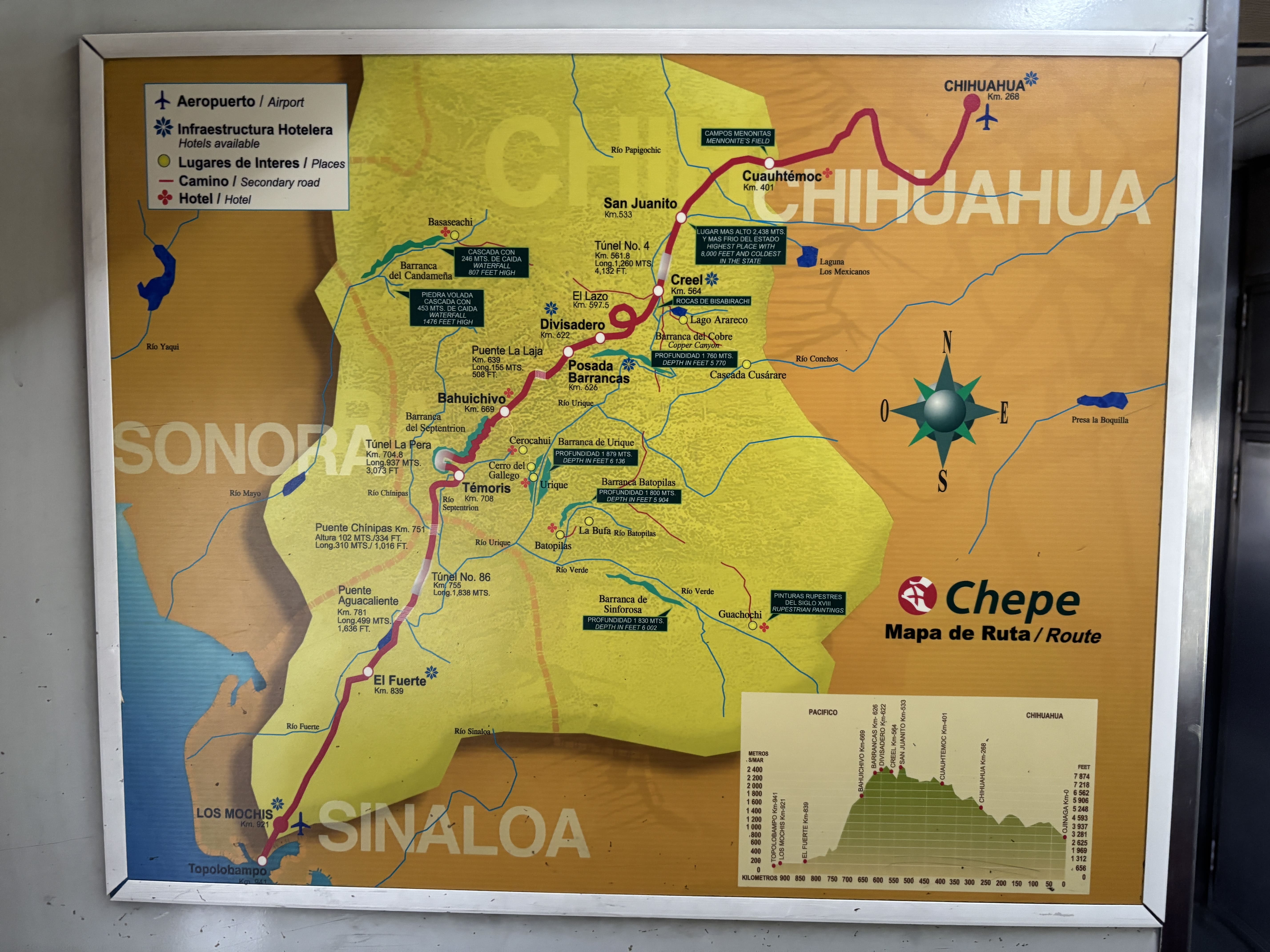
While some parts are more scenic than others, I don't regret travelling the full route.
I don’t regret taking the full journey though. Watching the scenery evolve from the plains of Chihuahua, to the valleys and rivers of the Copper Canyon, to the brush of Sinaloa, gaining or losing two kilometres in elevation and going from 20 to 15 to 40 degrees Celsius, all connected by a single thread of iron…that, to me, was worth every peso.
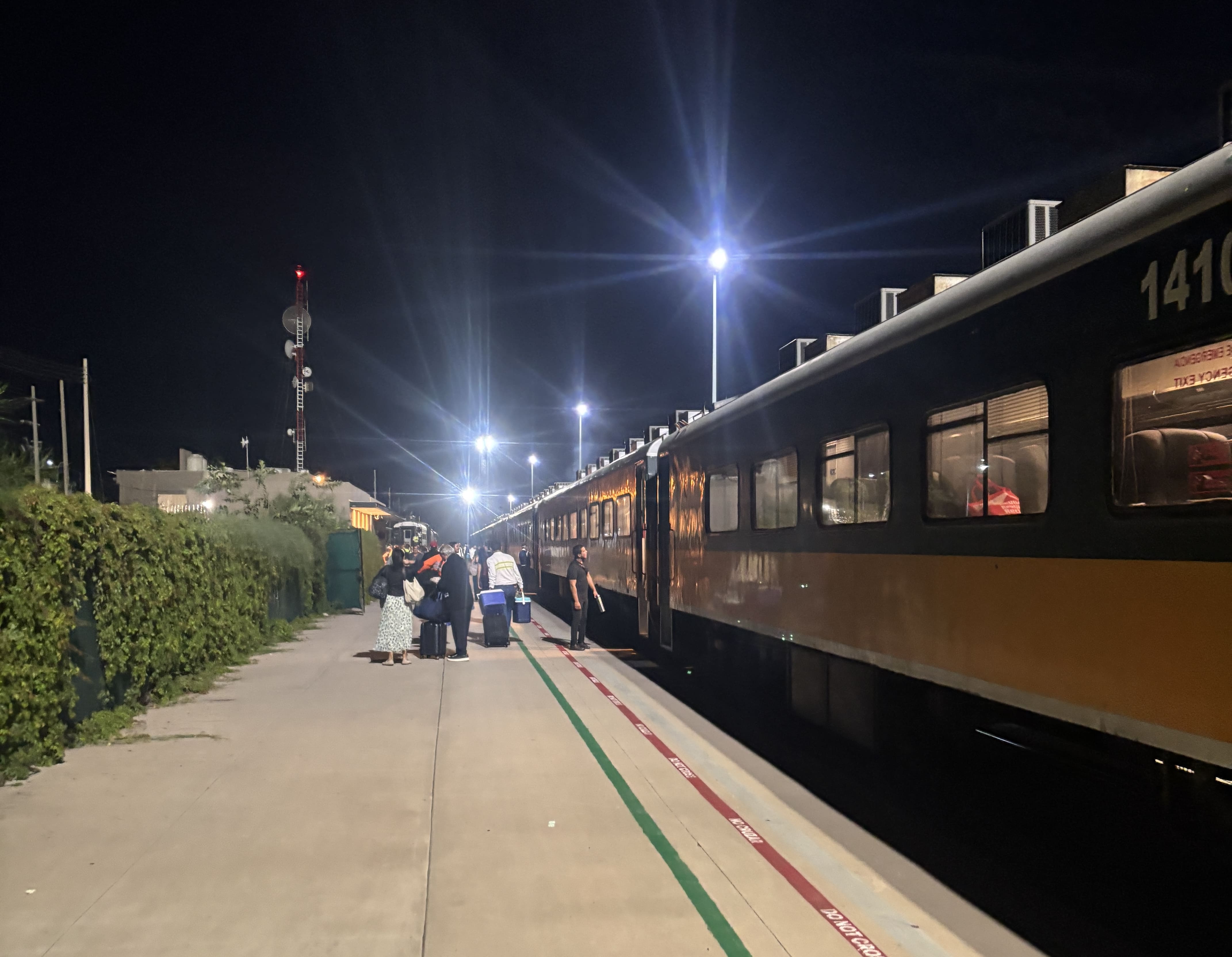
Arriving into Los Mochis, Sinaloa in the same darkness in which I had left Chihuahua four days and 668km earlier.