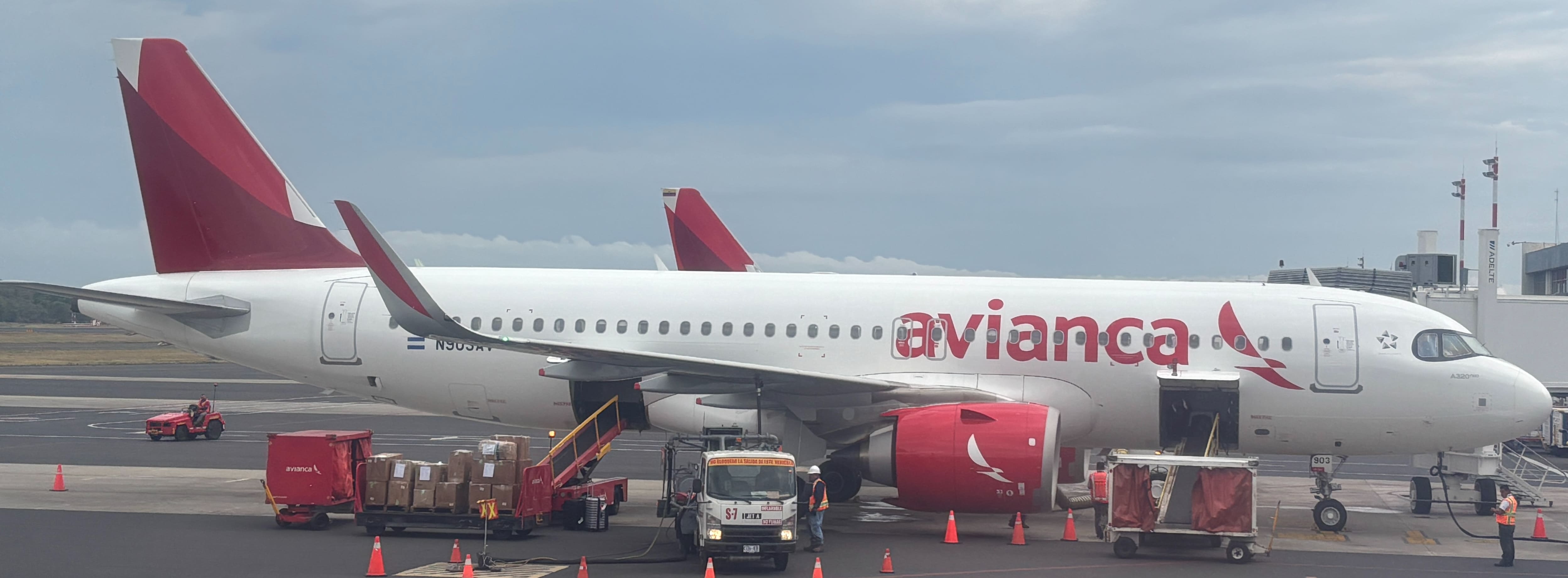
Avianca A320 Business Class Review, SAL to YYZ: Surprisingly Acceptable
Avianca business class has a horrible reputation: disparaging it is almost a rite of passage for any travel website. Honestly though, it's not that bad: it's not that good, but for the price and convenient connections you could do a lot worse (looking at you, WestJet "premium"). You get a hot meal, quirky but comfortable seat, and decent service. Here's where to set your expectations if you're considering the (usually small) upcharge to fly Avianca regional business class:
Introduction
Avianca is struggling with its identity. Limping along with massive debt from a series of mergers that led to its parent company becoming the second-largest airline group in South America, the Covid shutdowns finally did them in and they went through “bankruptcy-lite” (chapter 11) in 2020. They emerged from this with a leaner fleet of solely A320 and B787 family aircraft, and cut their business class product within the Americas to follow a low-cost model. This is still their approach in economy, where you’ll find a sub-human 28 inches of pitch, no recline (or “pre-reclined” to use their marketing balderdash), and no included bags on the cheapest fares.
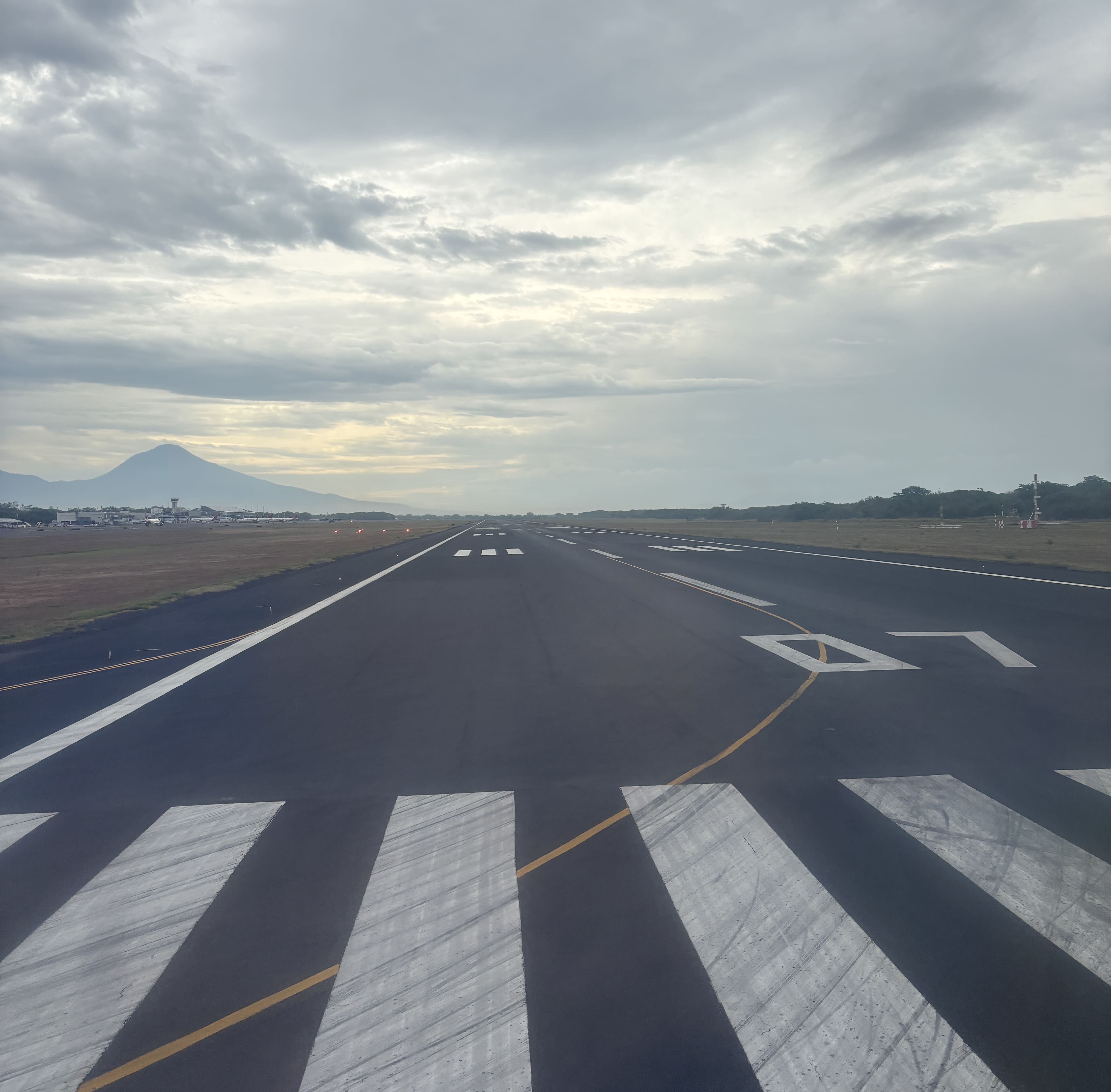
A cloudy morning departure from El Salvador's beautiful international airport.
Despite this low-cost image, the carrier re-introduced regional business class on July 1, 2024. I had booked a premium seat from Bogotá to Toronto in October of that year, which the carrier was re-branding as business class: rather than boot me back to, say, an exit row, I instead got an email informing me that I had been upgraded to their soon-to-launch business class for free. The experience wasn’t great, but this gesture earned some goodwill from me, so I decided to give them another go on my way back from Central America.
The experience is still below what you would get on most North American carriers, but it has improved drastically in a year and a half.
Check-In and Security
Avianca business class customers have access to a priority check-in lane…but can’t actually use this to check-in. Instead at airports that have them, all passengers, regardless of fare, must use self-serve kiosks, with the “priority” lane being exclusively for bag drop. I remember this being the case even at Avianca’s flagship hub in Bogotá.
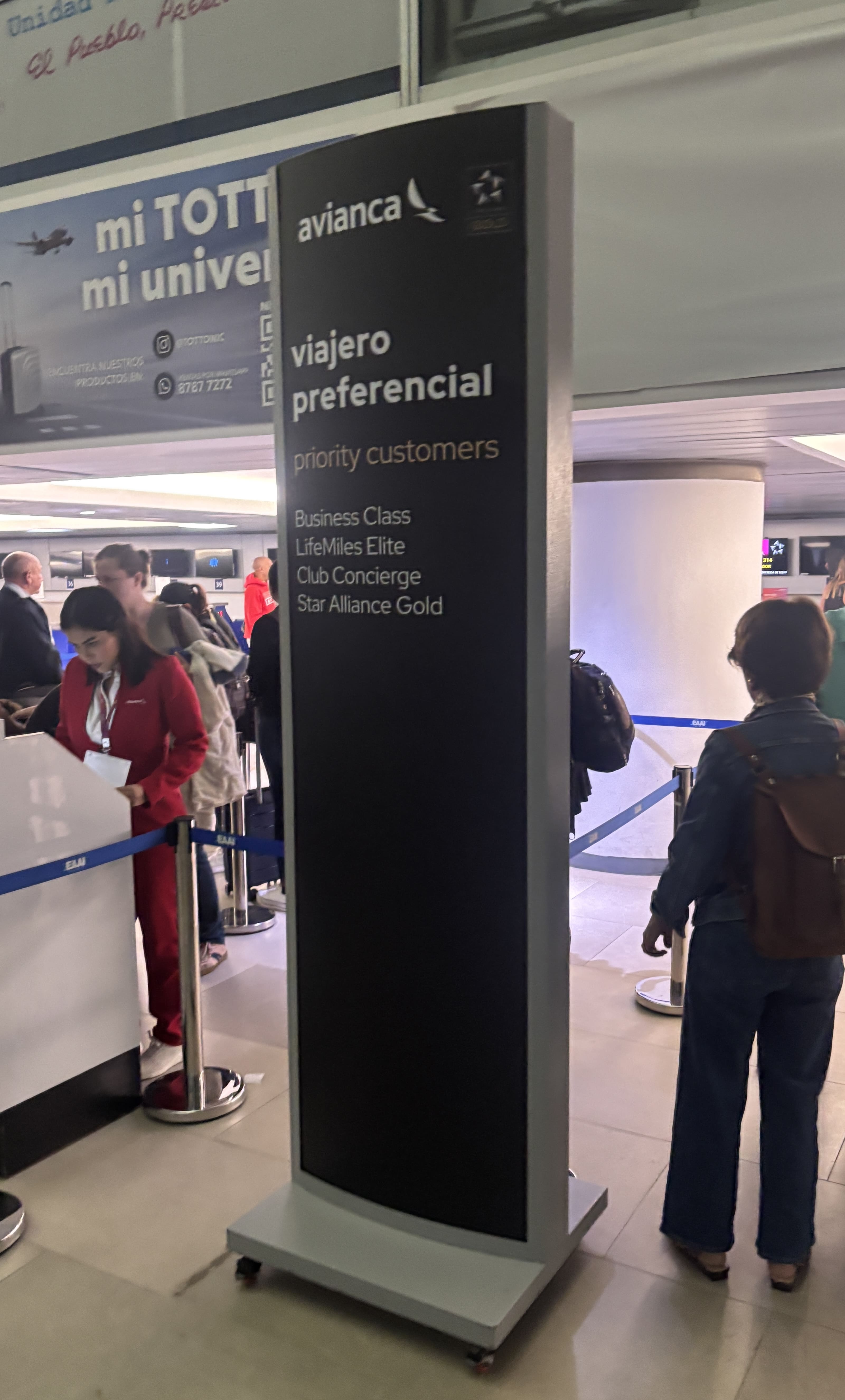
Business class passengers get access to a priority check-in lane, not that it does much good without a checked bag.
In the grand scheme of things, this is a minor point. But part of the appeal, for me, of business class is forgetting about the incessant nickel-and-diming of modern air travel: you don’t need to worry about convoluted baggage rules, seat assignments, downloading an app, or checking in online to avoid a fee for a paper boarding pass. Your flight leaves at hour X, you show up at the airport at around X minus two, and you’re handed a piece of paper that gets you on to a metal tube that brings you home. That’s it.
I spared the poor airport employee this mini-rant, and without being prompted he did complete check-in at the kiosk for me, which I suppose is the next best thing. But really: the agents are there, how much money is Avianca saving by forcing passengers to line up twice?
Paying to have human check-in agents who cannot actually check passengers in is the worst of both worlds.
My full itinerary was Managua-San Salvador-Toronto. In MGA there is no Gold Track security line, though it wasn’t necessary: our flight was the only one leaving for hours, and as I would soon find out it was only a third full. Transiting in San Salvador was straightforward with no need to clear customs, though as is common when flying from Central America to the U.S. or Canada, you do have to go through the security theatre at the gate even as a transit passenger. This includes security helping themselves to any liquids passengers purchased airside.
Lounge
The Avianca lounge in San Salvador is quite bad for a flag carrier lounge at a major hub, and even as a contract lounge it would be on the lower end of okay. Avianca lets virtually anyone in: the expected Star Alliance Gold and business class passengers obviously, but also every lounge membership and credit card going. For the handful of passengers who can’t get in anyway, Avianca sells access for a mere $25 US…which I thought was cheap before going inside.
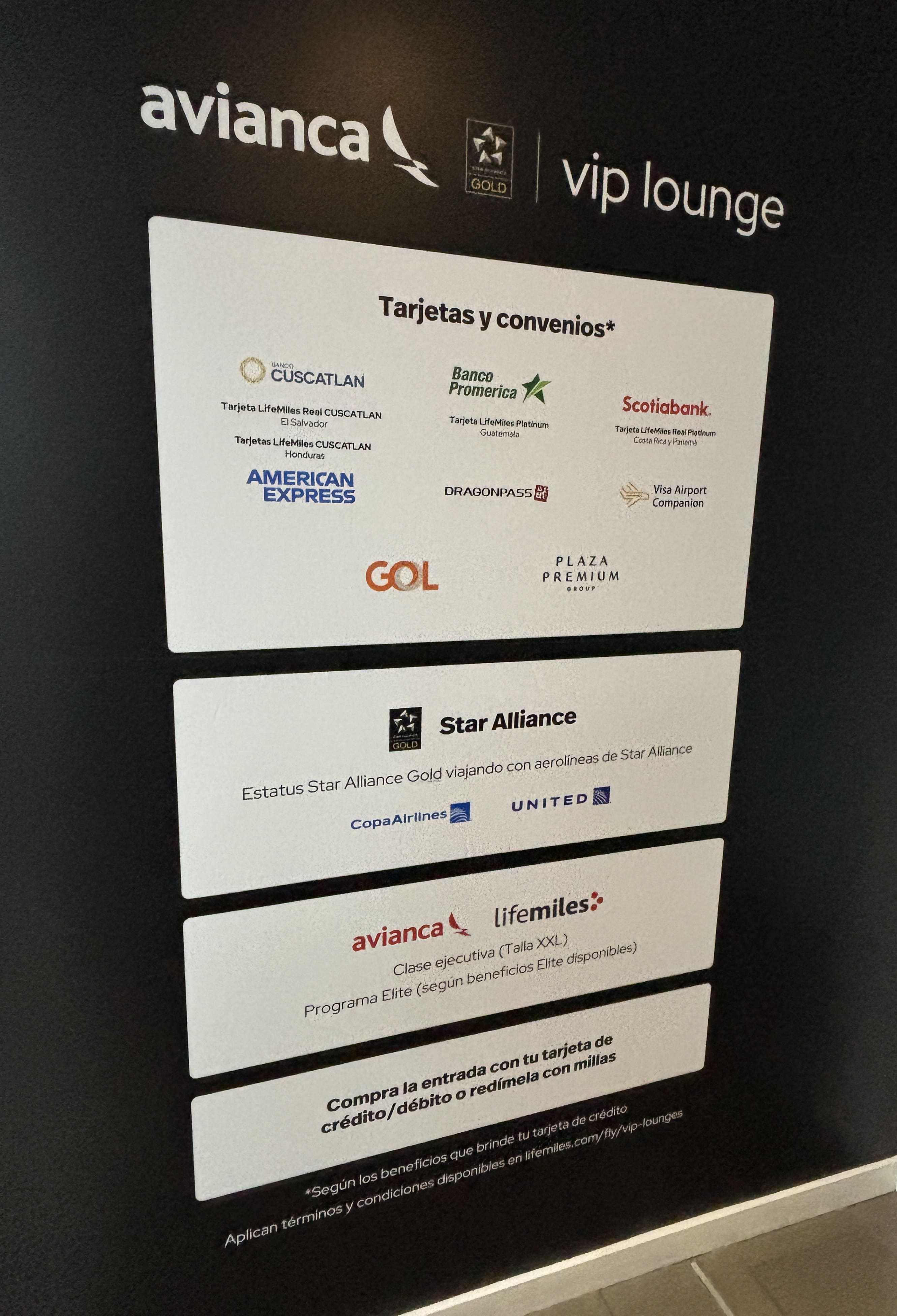
It would have been a smaller sign had Avianca just listed who does not qualify for lounge access.
Thanks to these generous access policies, there was a line to get in though this moved quickly. There weren’t many available seats, but around 15 minutes after I entered a bank of flights started to board and the lounge emptied to around half of its capacity. No seats offer ramp views unfortunately.
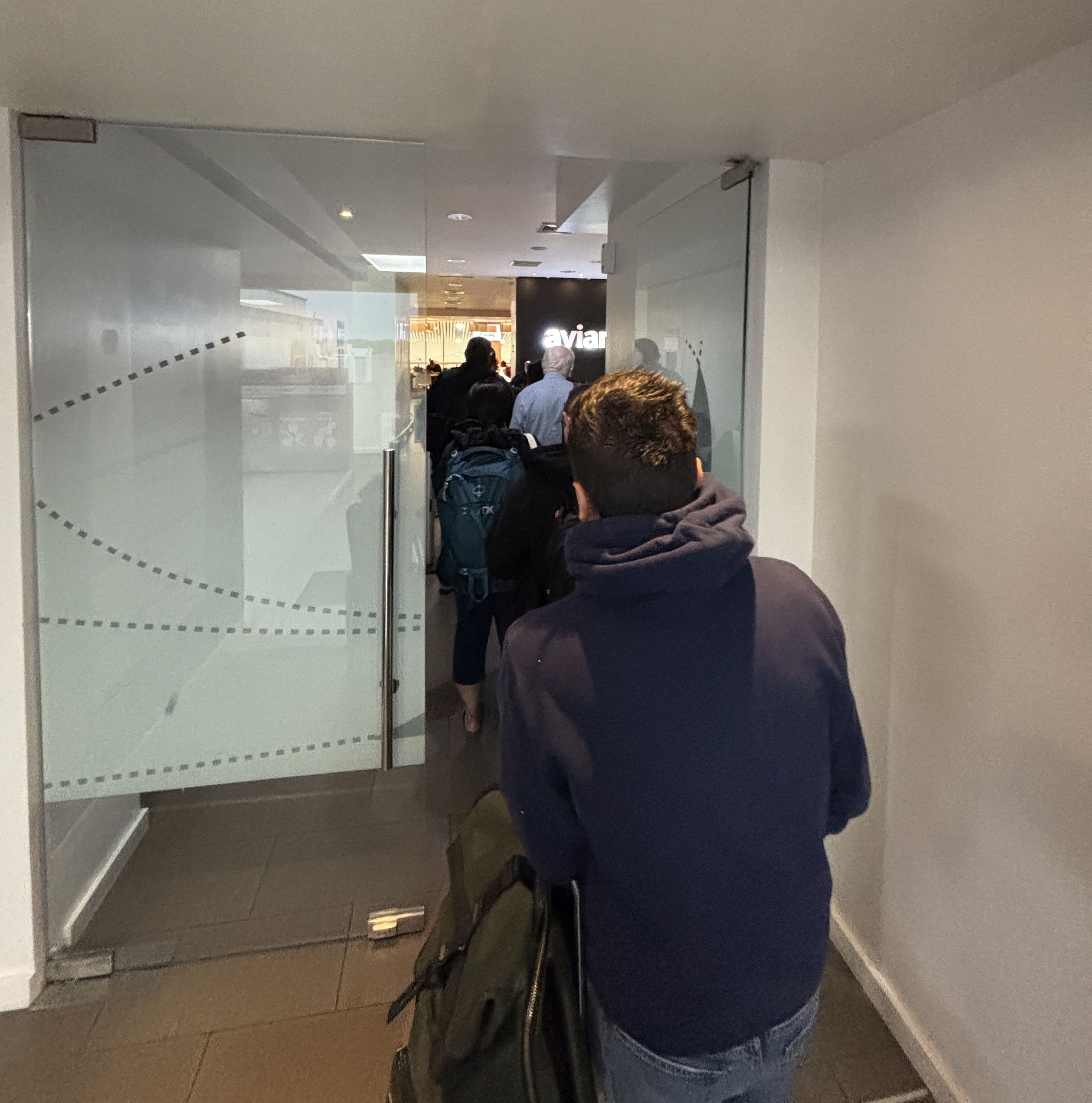
The line moved quickly, though even a short wait isn't really worth it.
I was there around 07:00 local time, so breakfast was being served. Hot options included eggs, pancakes, potatoes, and a salsa/hot dog sauce common in South and Central America. Hot food is served by staff on small plates, though you can go up as many times as you’d like (and recalling the measly food offerings on my last Avianca flight, I did). There were also cold cuts, a small selection of pastries, and cereal.
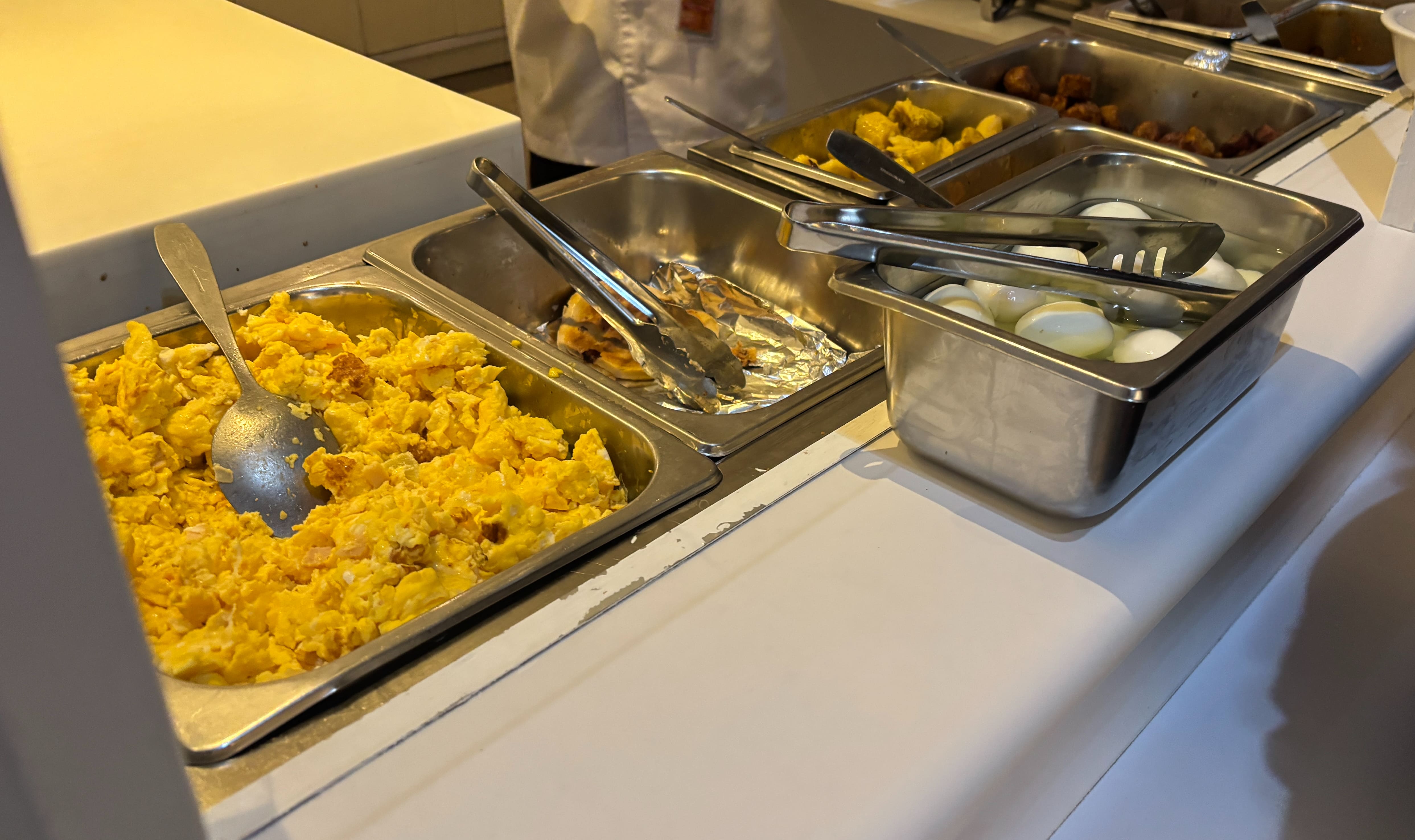
It's not much, but enough to fill the tiny plates provided.
There were two automatic coffee machines in the lounge: the one next to the food always had a line, the other one never did. It will never cease to amaze me why some of the best coffee growing countries serve some of the worst coffee…I don’t know what unholy combination of beans and chemical milk was dispensed into my cup, but it tasted more like a slightly-off hot chocolate than a cappuccino. Still, at least I didn’t have to line up for it.
It’s worth noting that alcohol is not served until 14:00, which is just plain cheap. For reference on my last visit to the domestic Maple Leaf Lounge in Toronto you could get a drink as of 11:00, and in lounges across Europe self-serve beer and wine is common around the clock.
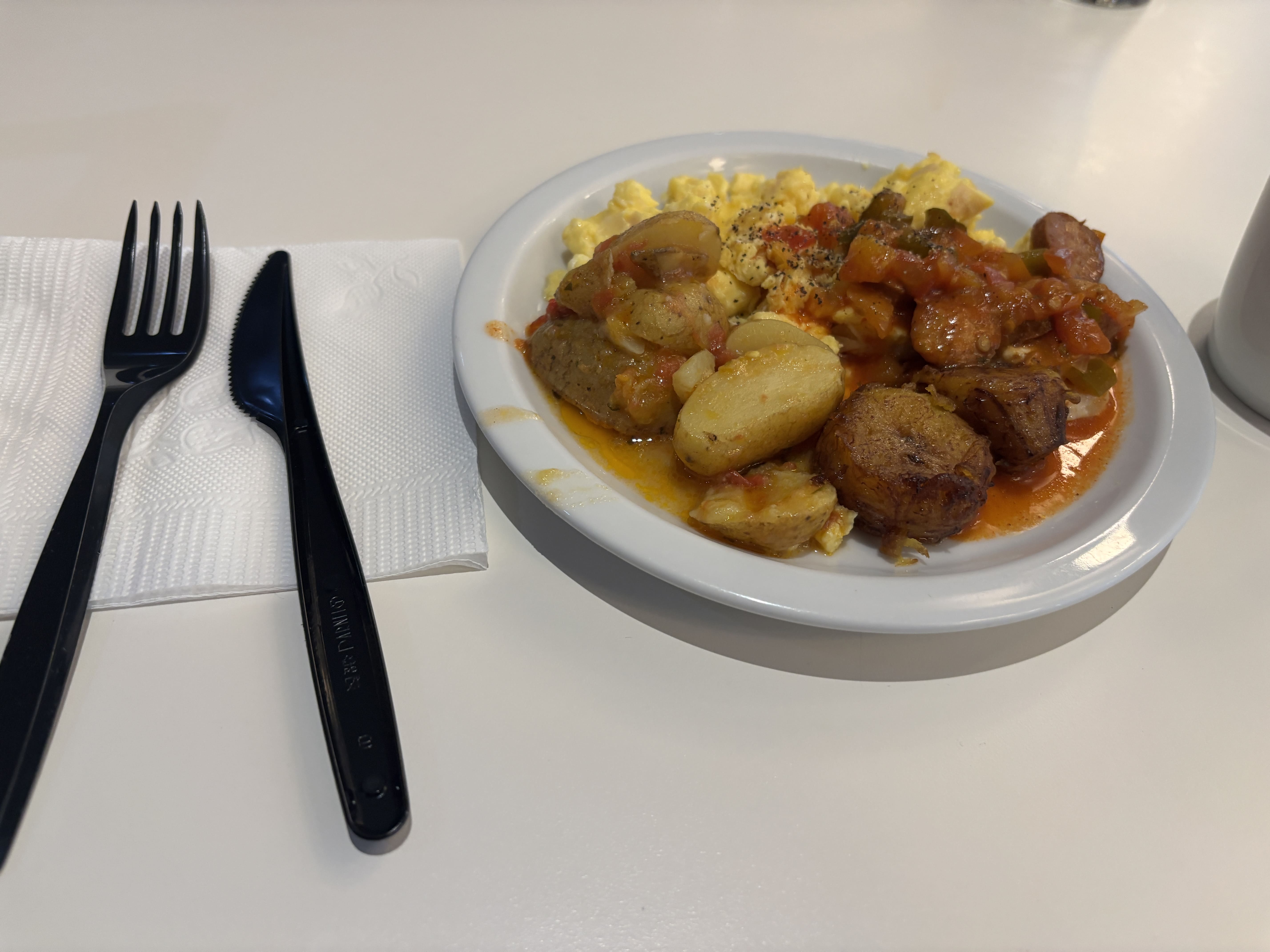
The plastic cutlery is reflective of the quality of Avianca's San Salvador lounge.
Seating options were limited: most chairs were hard plastic, with some more comfortable padded chairs that led into a rest area, where you will find lounge chairs suitable for sleeping. There is also a children’s room and media room, along with work stations immediately to the left upon entering the lounge. Down that same corridor you’ll find the toilets, with a sign saying that shower suites can be booked at reception.
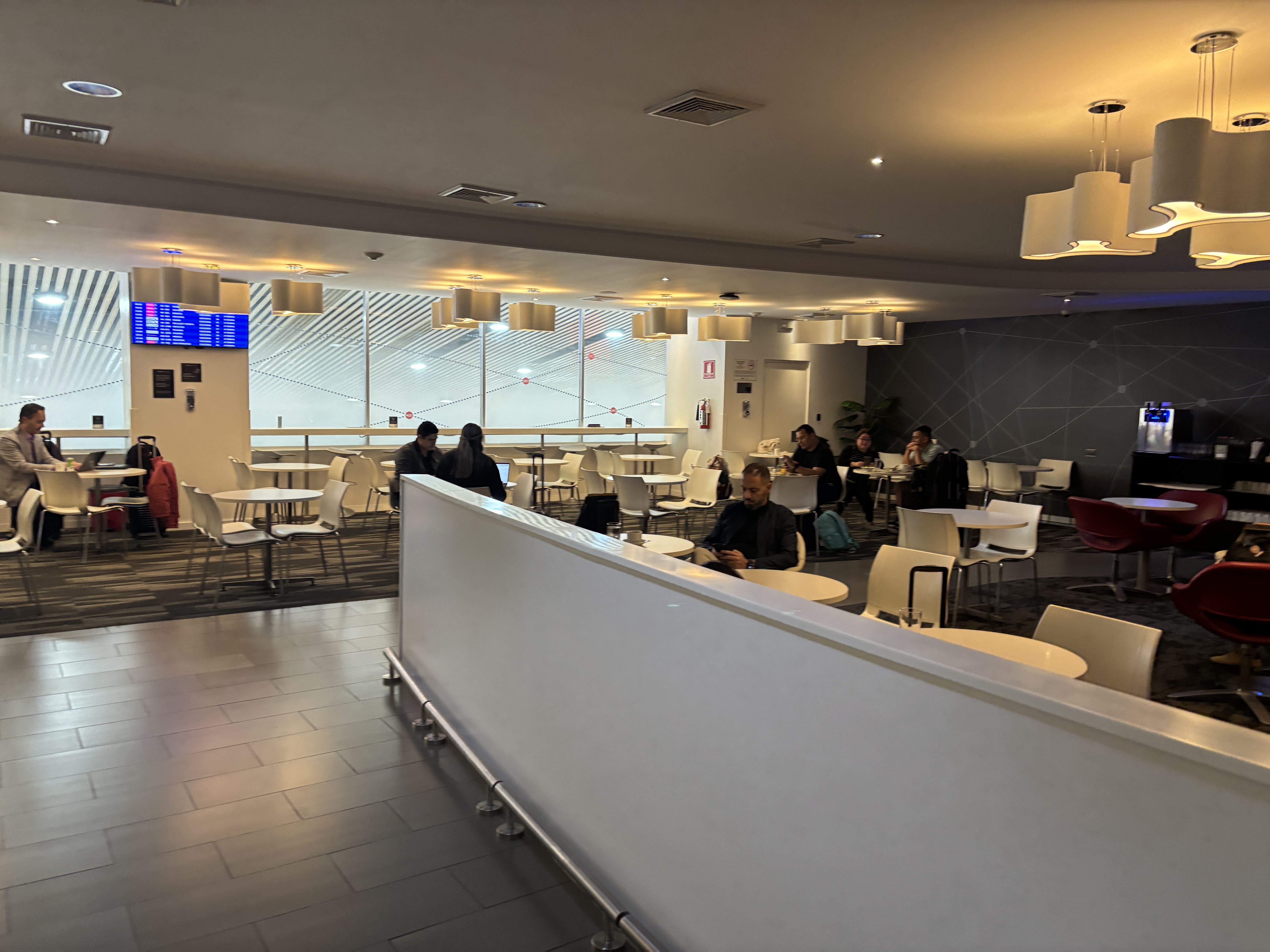
The sterile decor does not invite an extended stay.
On account of the performative security check at the gate I left the lounge around 45 minutes prior to my flight’s scheduled departure.
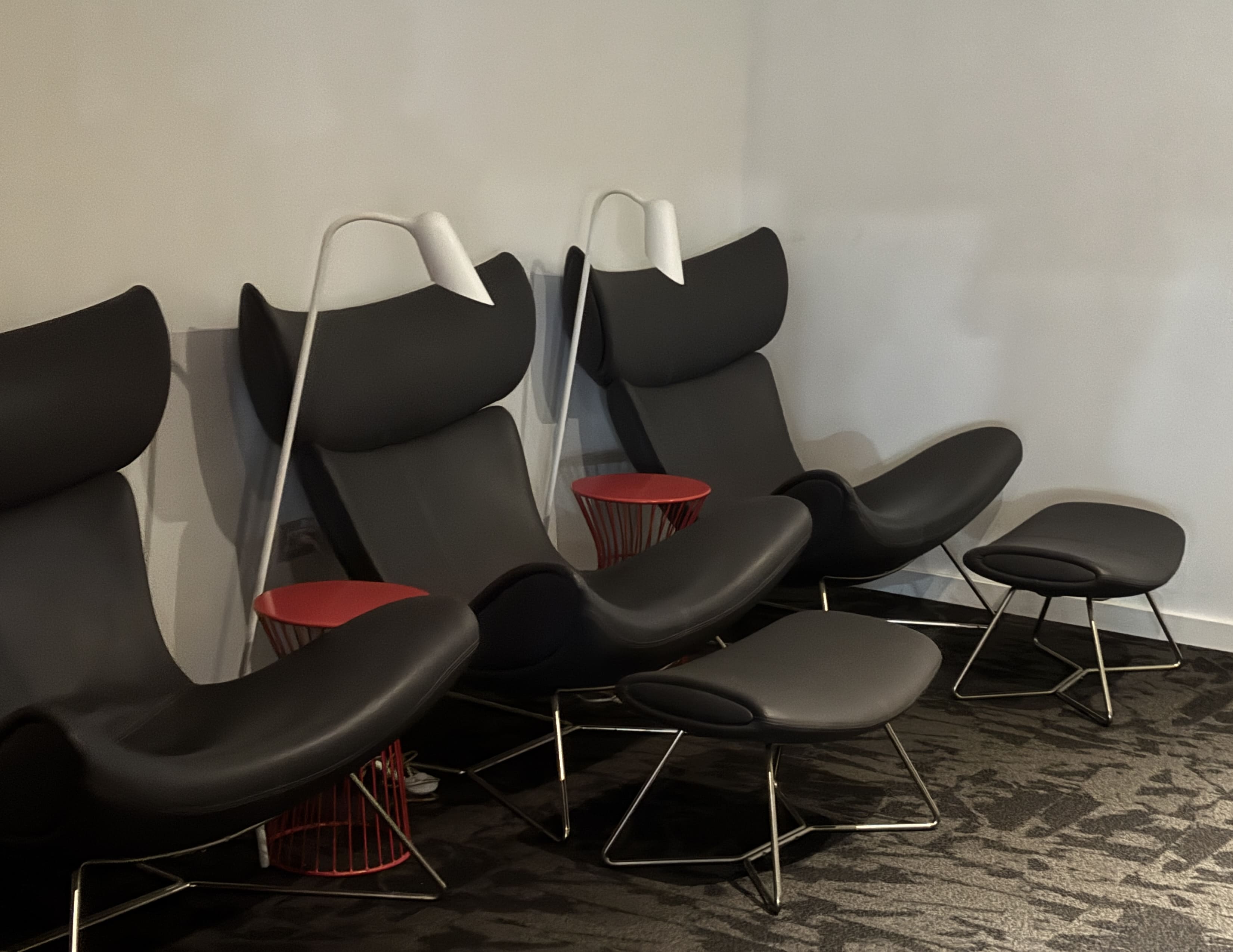
It's not exactly a bed, but it'd do in a pinch.
Boarding
Business class passengers board in group one on Avianca, immediately after those who come forward when special assistance passengers are invited to board. A flight attendant was checking boarding passes in the forward galley which isn’t unusual, and usually I will just say my seat number and move on…though oddly all passengers were required to once again show their passes to, as the flight attendant put it, “make sure you’re on the right flight”. Not exactly inspiring confidence in Avianca’s gate staff, though I suspect the real reason is to enforce assigned seats: multiple times during boarding passengers were asked to sit only in the seat on their boarding pass. Fair enough, though Avianca brings this problem on themselves by charging to select seats even at check-in on some economy tickets.
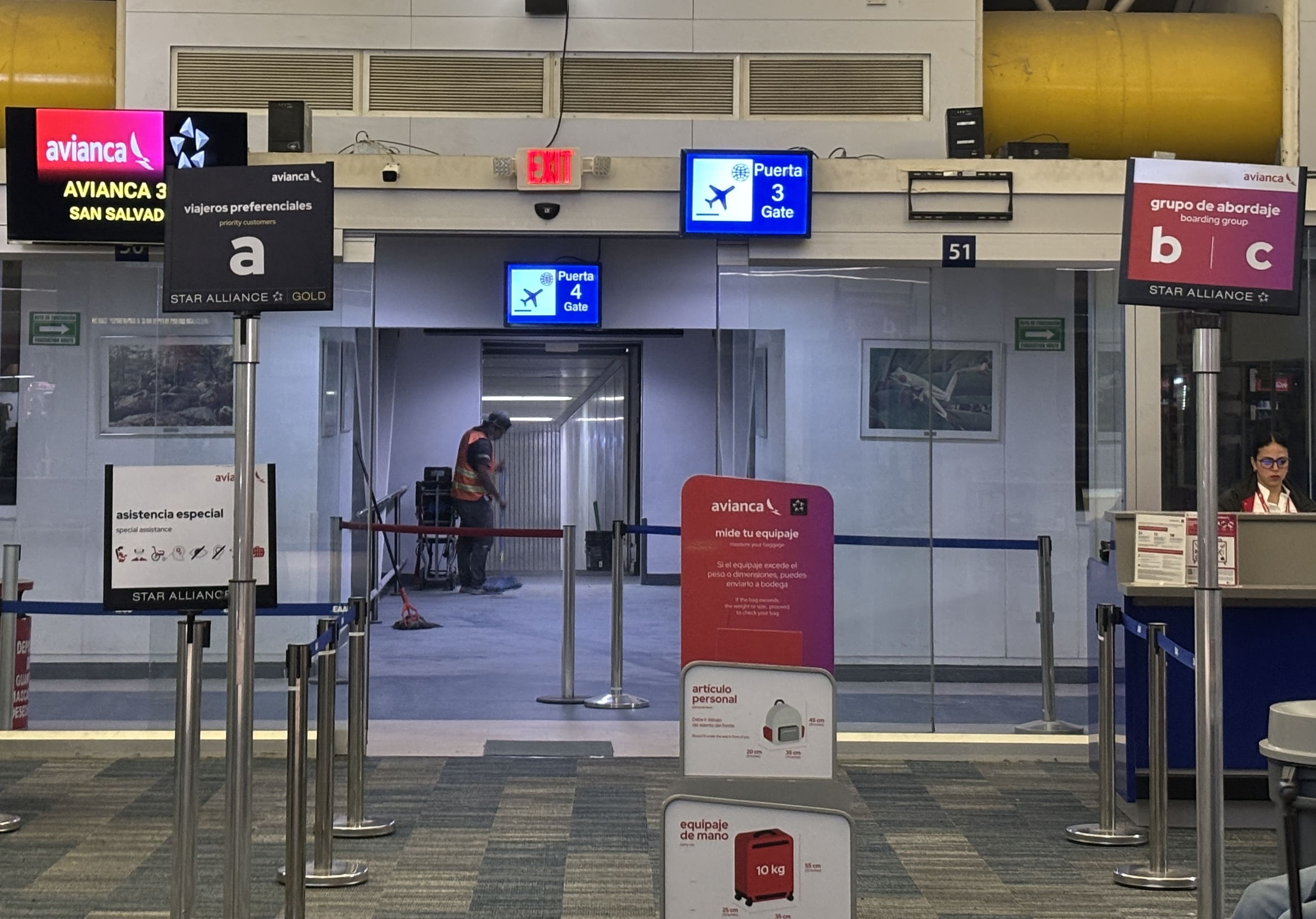
Business class passengers board in group one, or group a as Avianca calls it.
Avianca employs a high-touch service approach on boarding. Business class passengers are greeted by name and handed a bottle of water and small card welcoming you on board. Later, amenity kits are handed out from a tray. This is a change in service flow: these kits used to be placed inside the bag containing the pillow and blanket. By the time the door was closed I, and all other business class passengers, had had three short interactions with the cabin crew member who would be taking care of our cabin. Unfortunately the plastic water bottle was the extent of the pre-departure beverage service.
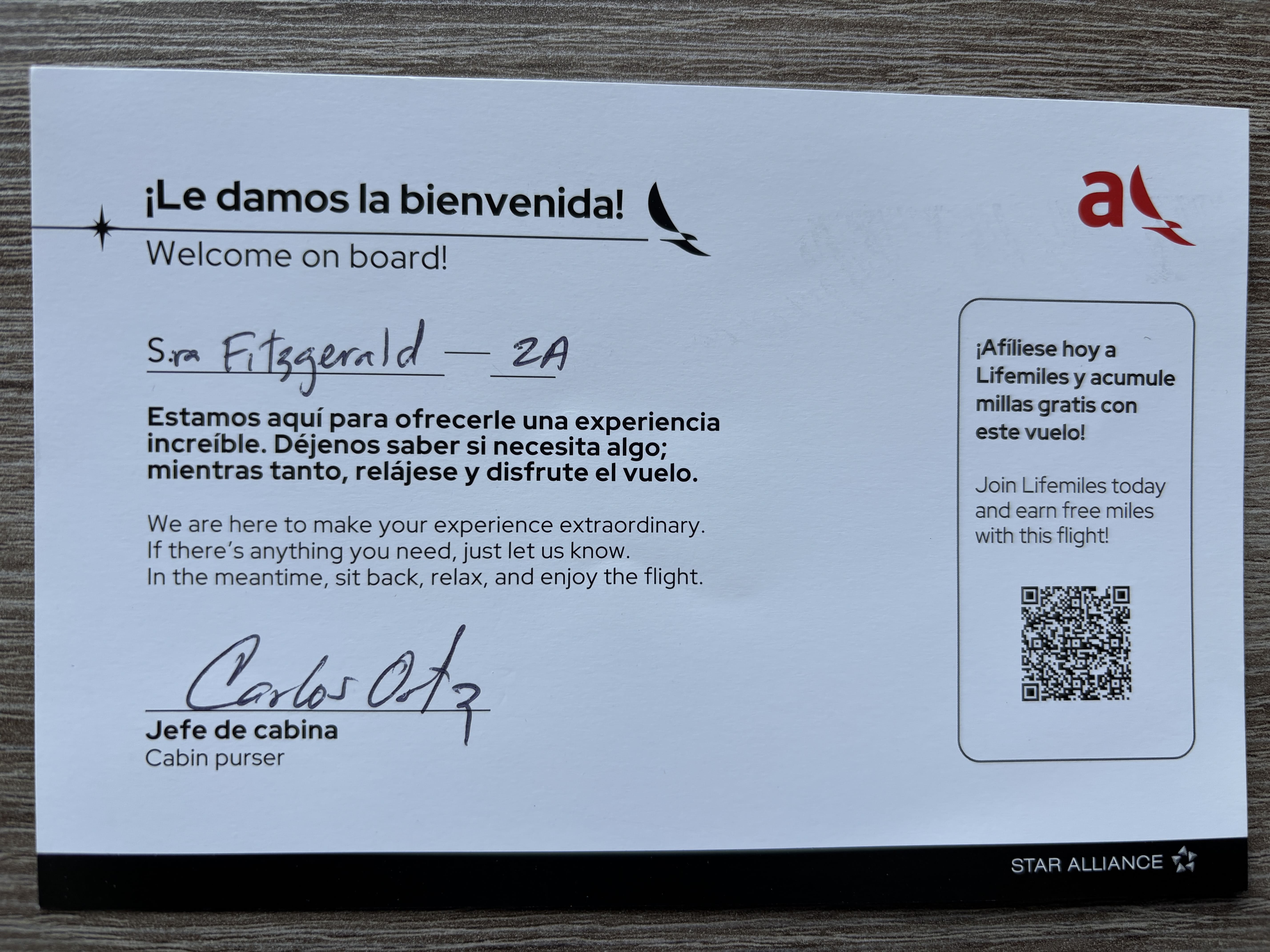
The welcome card is a nice touch, even if the lead steward seemed to think that I was a woman.
Avianca prides itself on its on-time performance, and of the nine flights I have taken with them, not one has been delayed. This time was no exception, and we pushed back a few minutes early.
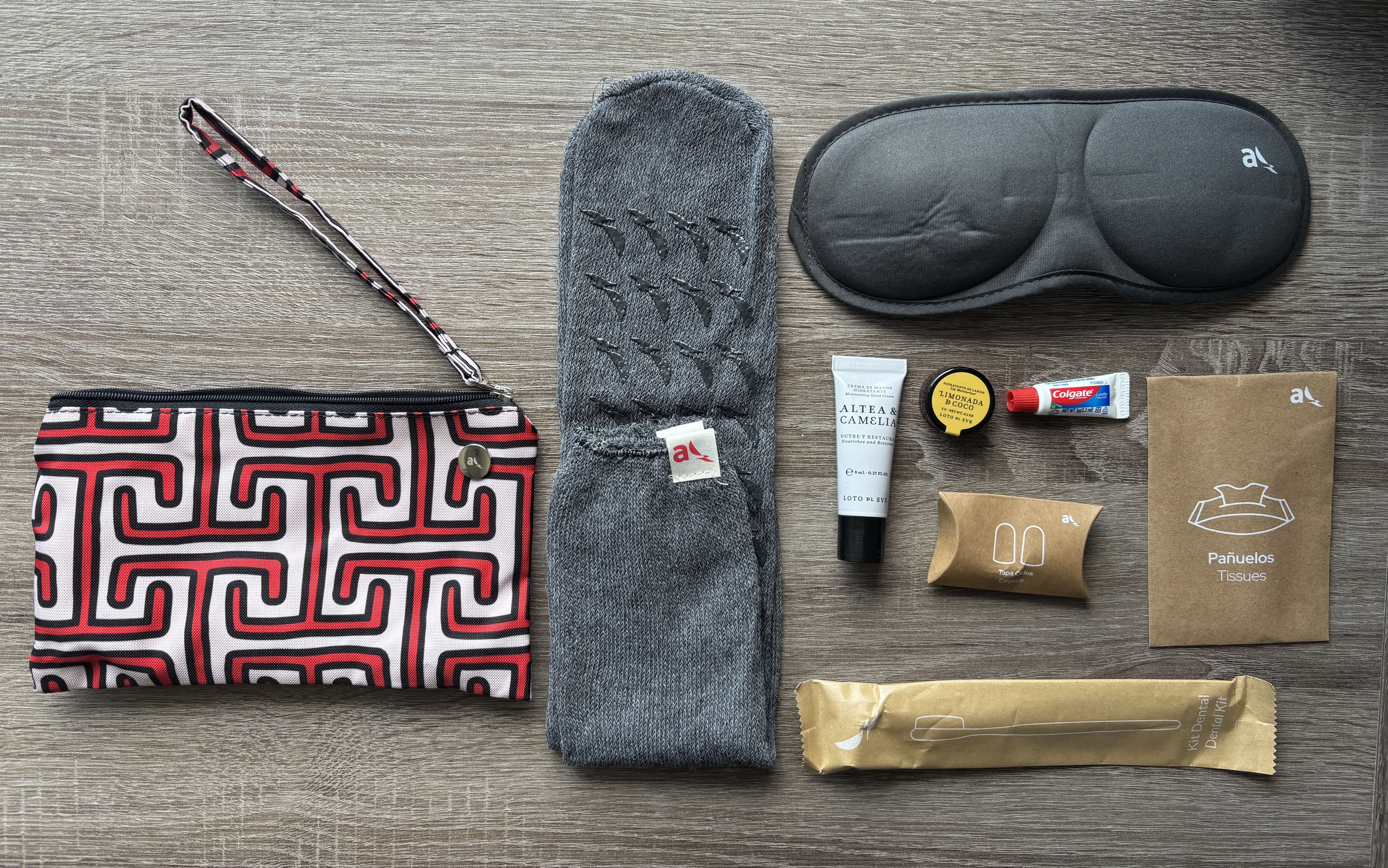
This would be acceptable as a long-haul amenity kit, and is excellent on a regional flight.
Seat
I commend any airline that tries something new with its seat design, rather than going with an off-the-shelf model. Avianca certainly went a different direction than its competitors, offering a seat that is above Eurobusiness but below the usual North American recliners. Seats are arranged 2-2, which is the norm, with three rows. The seat has the same “bones” as their economy product, however unlike on most European carriers where the middle seat is simply blocked, on Avianca it is re-shaped: from the back it looks like a normal economy seat, including a tray table that folds down for use by passengers behind you. Up front, the seat itself is replaced with a storage area that tapers to a point, making both the aisle and window seats noticeably wider. The seatbelt is unfortunately mounted as it would be on a normal economy seat, meaning you don’t get to make the most of this seat width when buckled in.
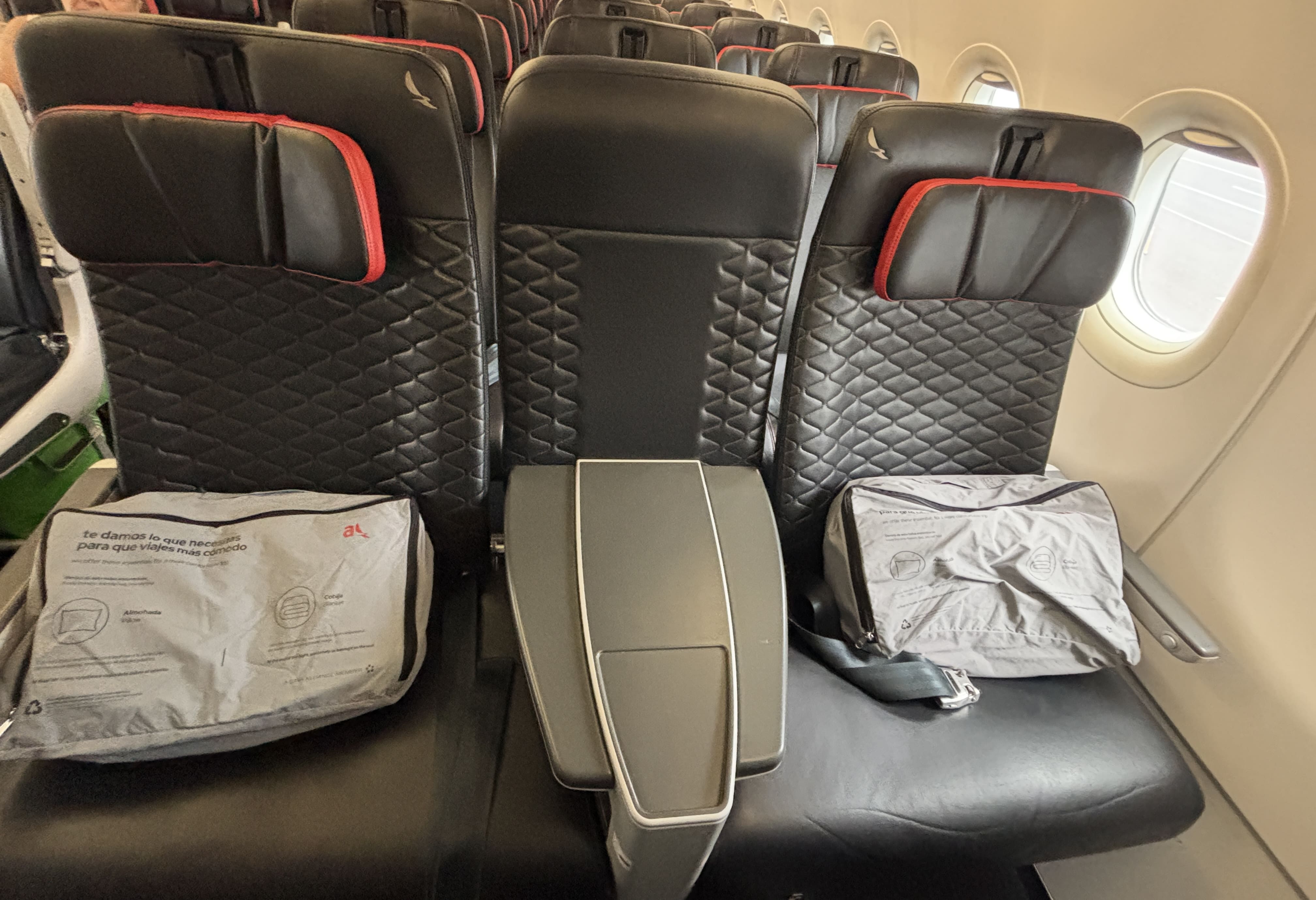
Innovation isn't always a good thing: this seat is unique, but a run-of-the-mill domestic First recliner would have been better.
Business class passengers on an Avianca A320 only get 33 inches of pitch, which is about 3-5 inches less than you would expect in U.S. domestic first, and only an inch or two more than is common in long-haul economy. At six foot three I could cross my legs only when the seat in front of me was not reclined; when he did put his seat back, the space was tight and as a window seat passenger, if both seats in front of you are reclined getting up is awkward and uncomfortable.
I booked the first row on the short flight from Managua to San Salvador to try it out, and would avoid booking business class if this is the only row available: there are no bulkhead cut-outs for your feet, and the legroom is unacceptably small for a business class product. Flying to Toronto I was in seat 2A, and very much needed the underseat area in front of me to stretch out.
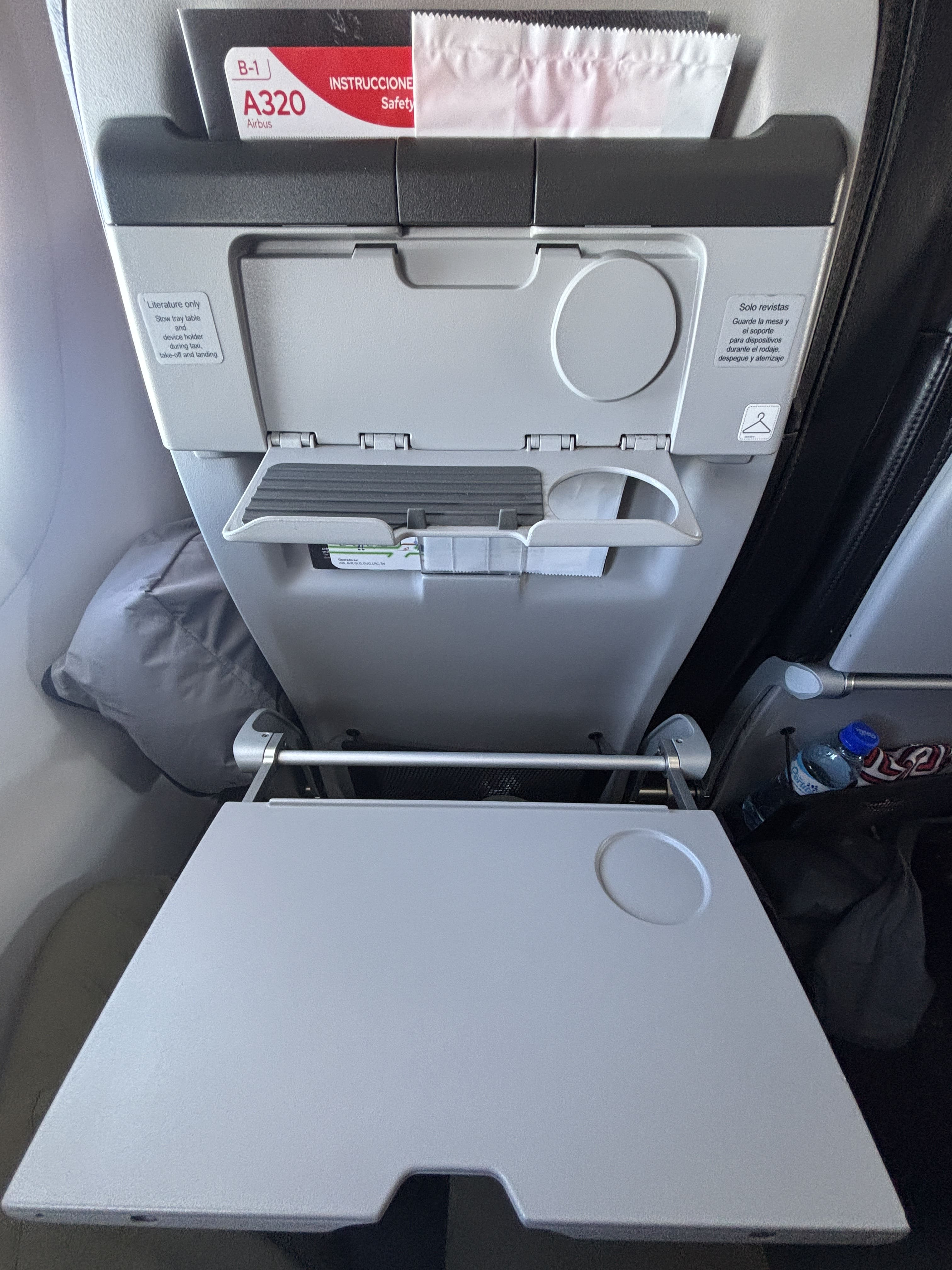
While no replacement for a proper IFE screen, the small device holder tray was handy.
Next to each seat you’ll find a small storage area, large enough for a book. Overhead you’ll find individual air vents and reading lights. The first three overhead bins are exclusive to business class, and this was enforced. The tray table folds down from the seat in front, or from the armrest in the first row. There is also a small device holder that folds down above the tray table, useful for watching the IFE (more on that below).
A pillow and blanket were waiting at each seat, in a grey cloth bag. The blanket was thin but comfortable. This being a daytime flight within the Americas (so not crossing many time zones) I didn’t sleep, and I wouldn’t relish the prospect of spending a night in this seat.
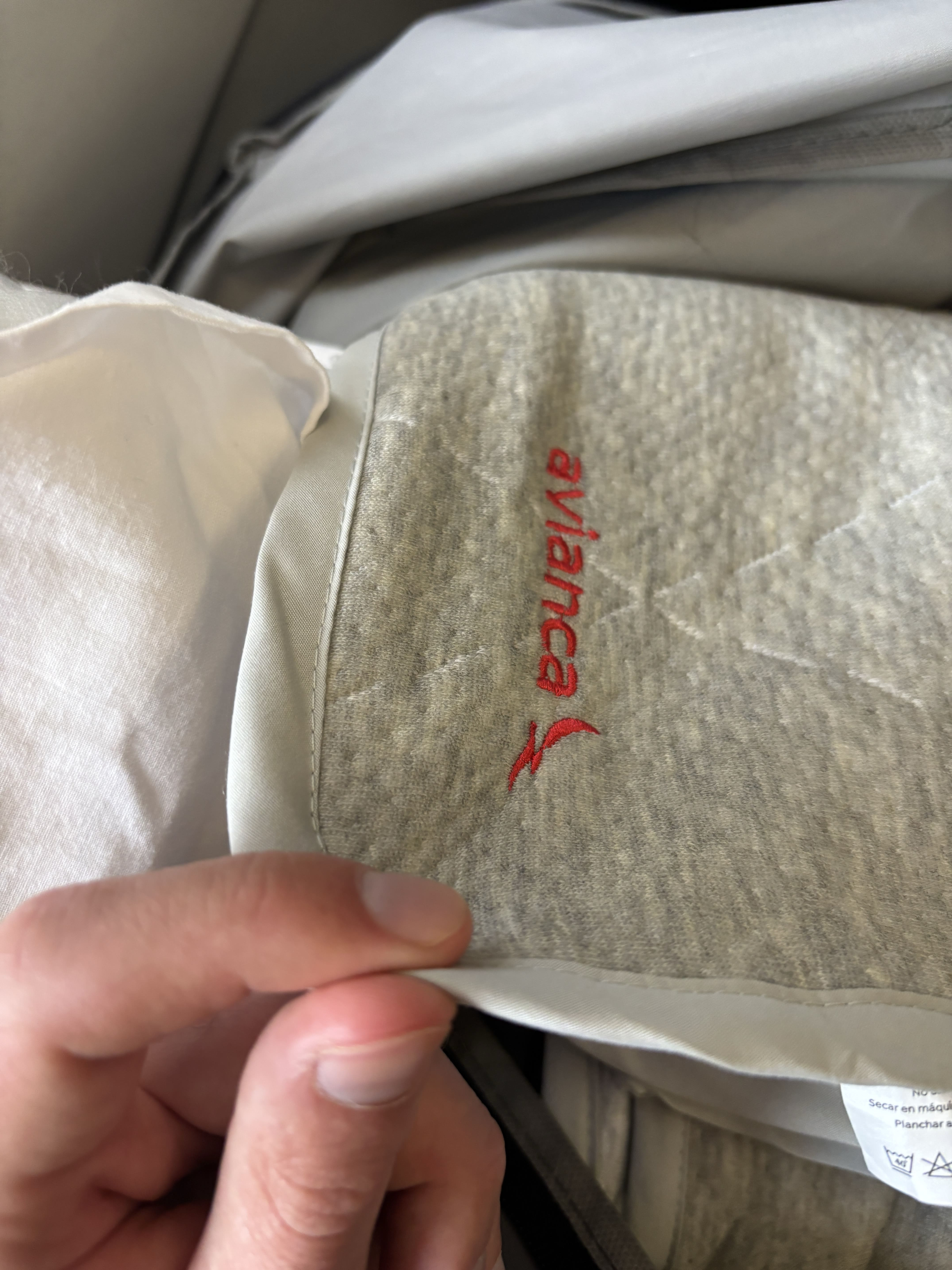
I can't be too harsh, because a pillow and blanket is better than anything you'll get on most flights of a similar length on other carriers in the Americas.
The literature pocket contains the expected safety card and airsickness bag, as well as the buy-on-board menu. Interestingly an advertisement for in-flight upgrades to business class noted an associated discount on purchased food, implying that those who upgrade mid-flight might not receive a meal service (which would make sense, there having been no way to cater said meal).
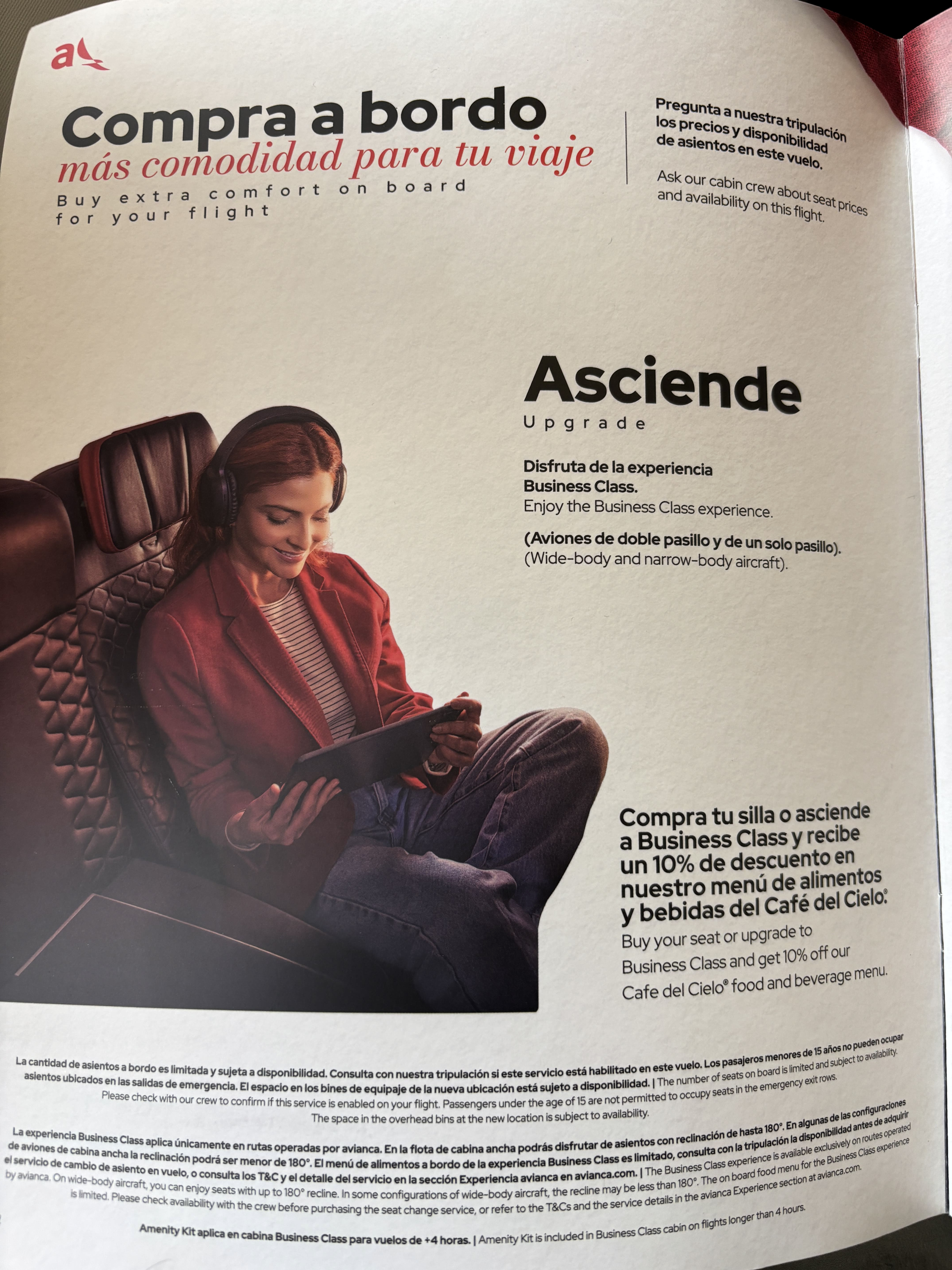
The promotional photos conveniently leave out the seat in front, which would make that leg cross significantly less comfortable.
All of my nine flights with Avianca have been in this seat, either as a premium seat or in business class once that was re-introduced. It is more comfortable than Eurobusiness, though for my money I would take the much better food and service of Eurobiz. Kudos to Avianca for bringing a unique product to market, but you’ll be more comfortable in a standard recliner on Air Canada, Delta, or the like.
In-Flight Entertainment (IFE)
Avianca does not offer on-board WiFi, putting it behind most of its competitors including its primary opponent in the South American market, LATAM. There are also no IFE screens in either economy or business: instead, entertainment is streamed to your device. There is usually a basic moving map option, though it never worked on this flight.
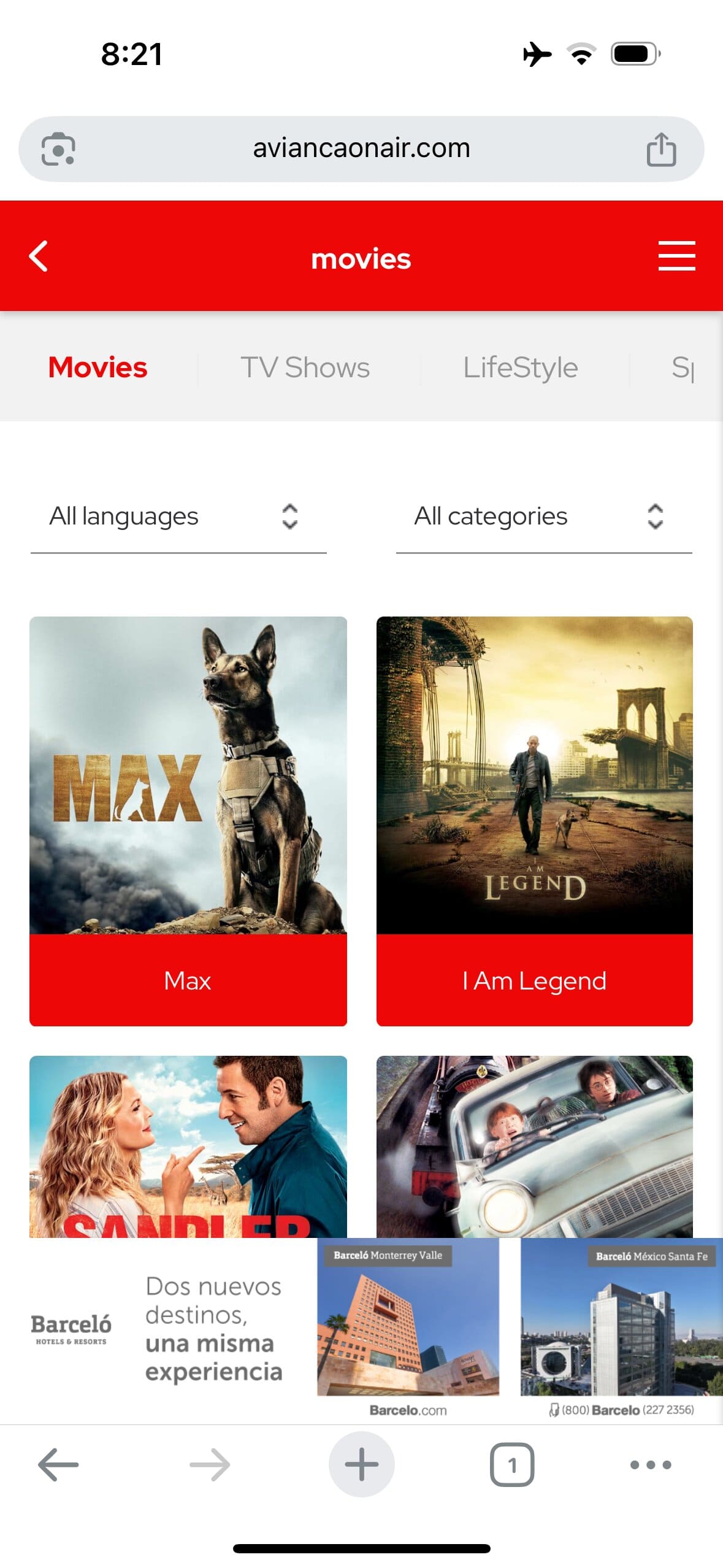
One hundred movie choices, but most are quite old and/or unpopular.
There were exactly 100 movies on offer, which is slightly annoying since it does rather seem like I made it up. There were also 30 television series. New releases were sparse, and Avianca does seem to have strongly considered licensing costs in building its IFE offering…I settled on The Dirty Dozen.
Below each movie/show description is a reminder to use headphones when watching IFE…the fact that this reminder is necessary was sad enough, though the fact that the individual in front of me felt it didn’t apply to him was worse. Crew were quick to turn my request into an instruction, but do note that there are no headphones provided on board: you need to bring your own, or pout for the rest of the flight.
Food
This was a low point on my previous Avianca business class flights, and still is. Drinks were served around half an hour after takeoff: I ordered a coffee and orange juice. The coffee was served with real milk, another improvement over previous Avianca flights where only the revolting powdered stuff was on offer. The orange juice was also decent, unlike the artificially-sweet concoction served in Avianca’s San Salvador lounge.
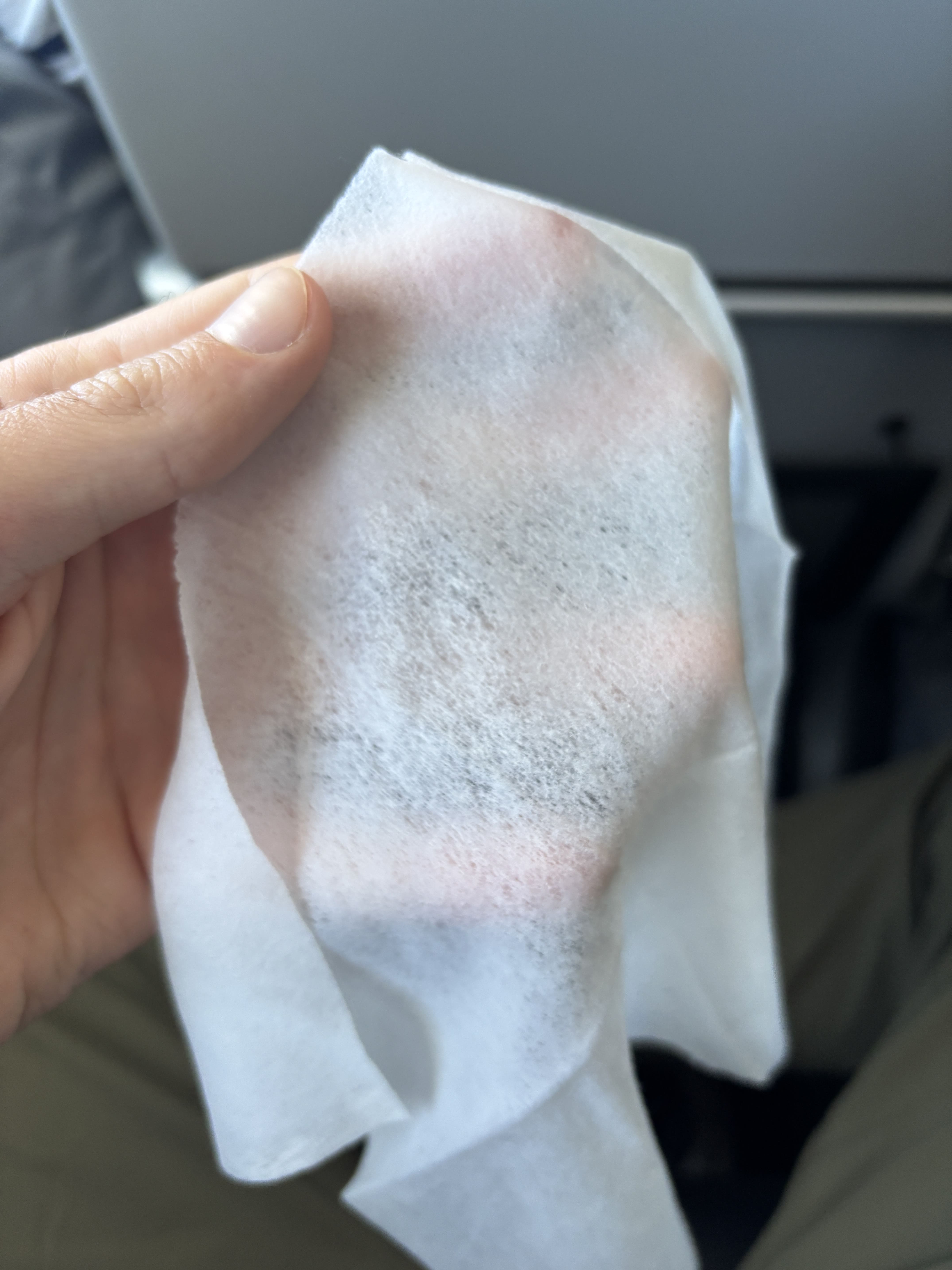
Calling this a hot "towel" is generous...it's more of a tissue.
This drink service flowed into the breakfast service. I prefer to have a quicker drink service shortly after takeoff, so I can relax with a G&T or, at this hour, a coffee while the crew heats up the meals, and then another drink served with the meal. A small point, but on a flight of this length (five hours) there is no rush and no need to accelerate the meal service.
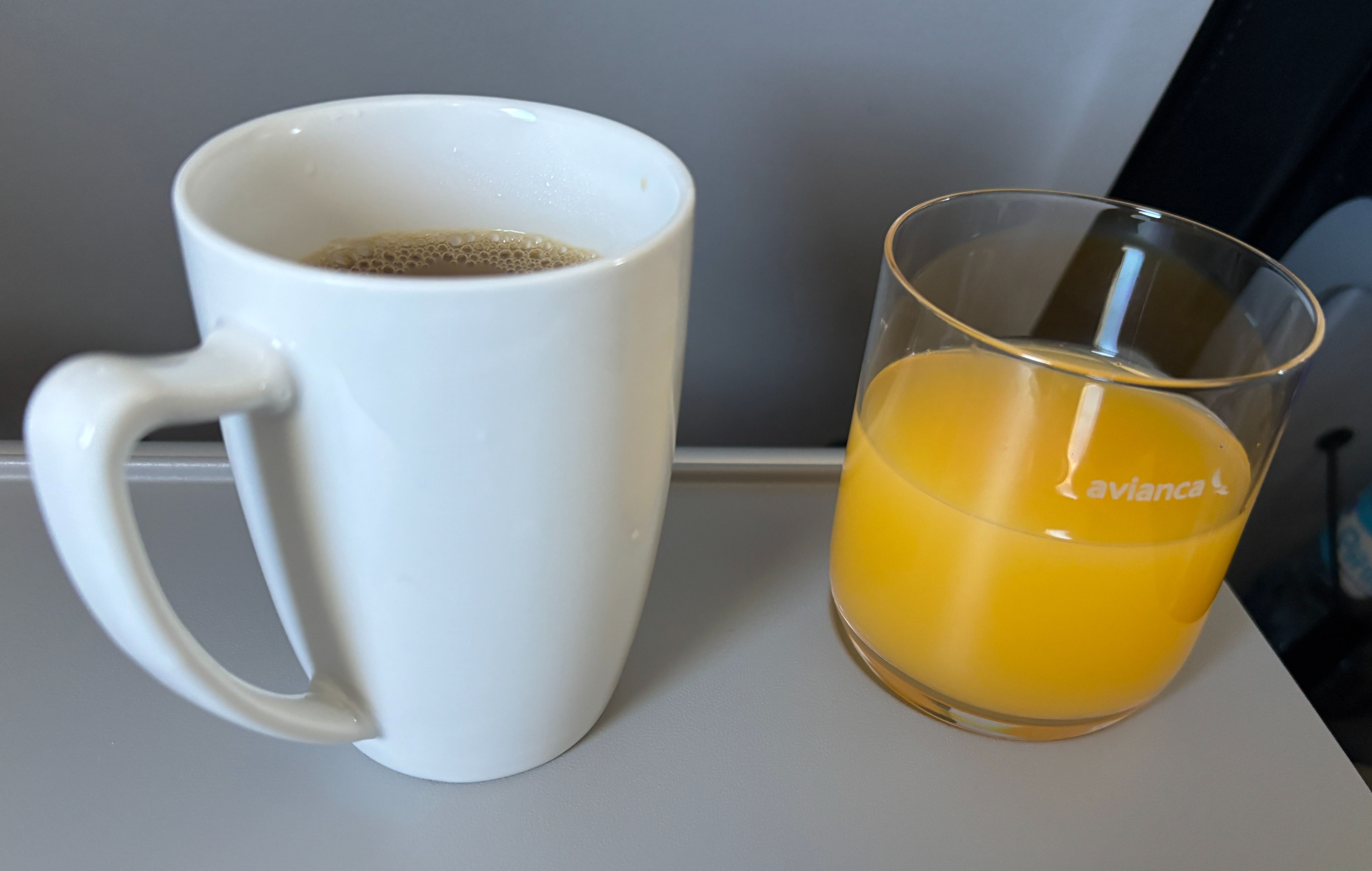
Drink service combined with a meal service isn't great, but I did appreciate the proper glassware.
Breakfast options were a quiche with bacon or crepes with orange and chocolate. I had my fill of eggs in the lounge so went with the latter. This was a bad idea: the crepe was stodgy and stuck to the plate, and the chocolate sauce was overwhelming. Granted that breakfast is the hardest meal for an airline to impress with, this was still an underwhelming attempt.
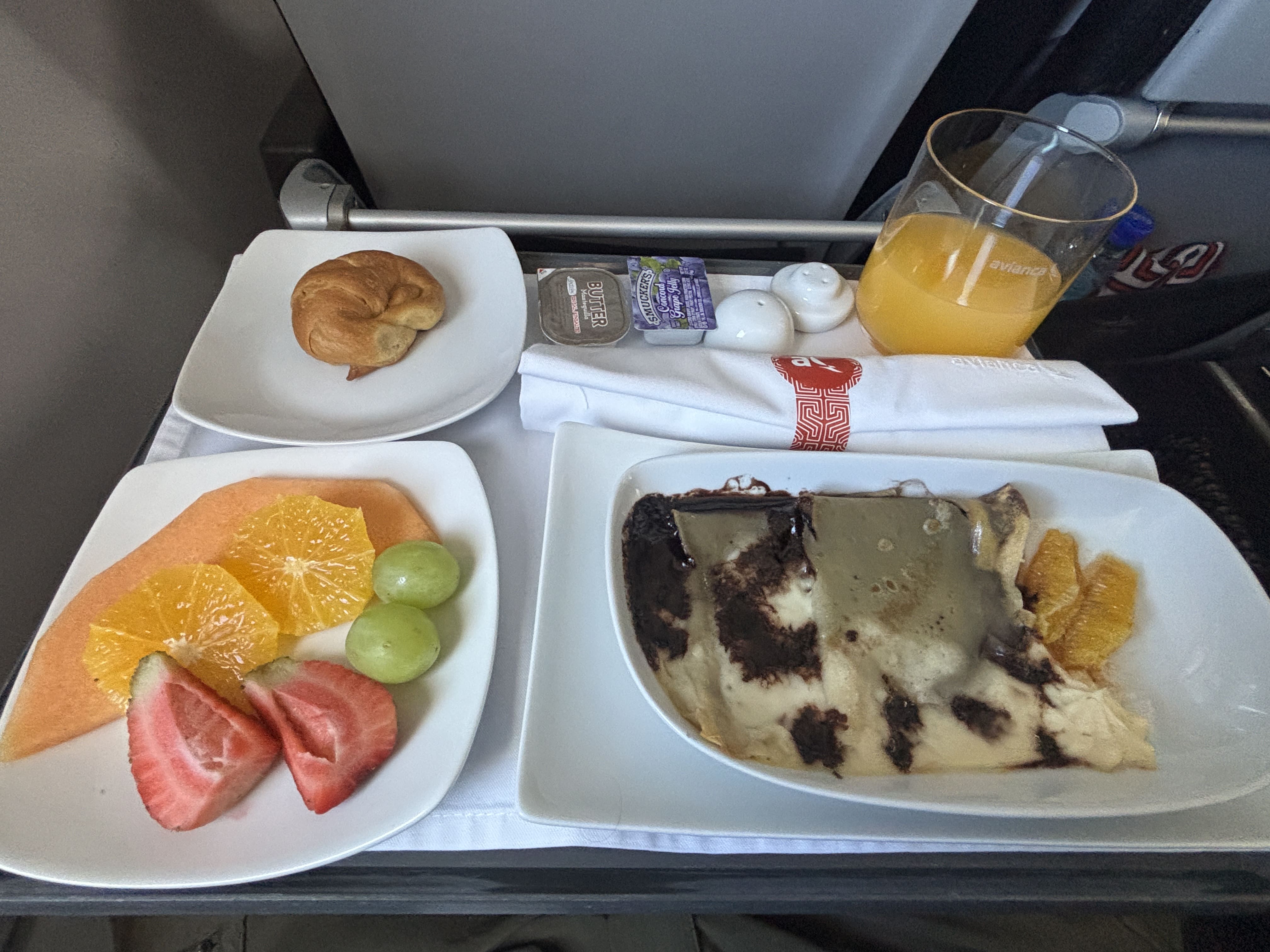
The crepe was terrible, and the comically small industrial croissant just added insult to injury.
At the three-hour mark a drink and snack service was offered. I had a whiskey and coke, having come to the conclusion that, being past the halfway point of the flight, I was free to jump ahead two hours to Toronto time. Snack options were cookies and/or chips. I wasn’t overly hungry thanks to my worst-case-scenario meal prep in the lounge, so just had a bag of barbecue chips.
All drinks were served in proper glassware, with glasses sporting Avianca’s logo. Metal cutlery is also provided, though no tablecloth was presented for the meal service. All considered, I’d consider Avianca’s breakfast offering a forgettable 4/10: edible, but below average.
Service
As with pretty well everything else about this flight, I found the service to be decent: not great, not bad. There was one flight attendant dedicated to business class, and he spoke both English and Spanish fluently. Trash was cleared quickly, and the one time I pressed the call button to deal with the ignoramus treating an A320 as his personal movie theatre, it was answered in seconds.
At the same time service was not proactive: there were no regular passes through the cabin, and outside of prescribed meal and snack services, the crew did a lot of sitting behind the curtain.
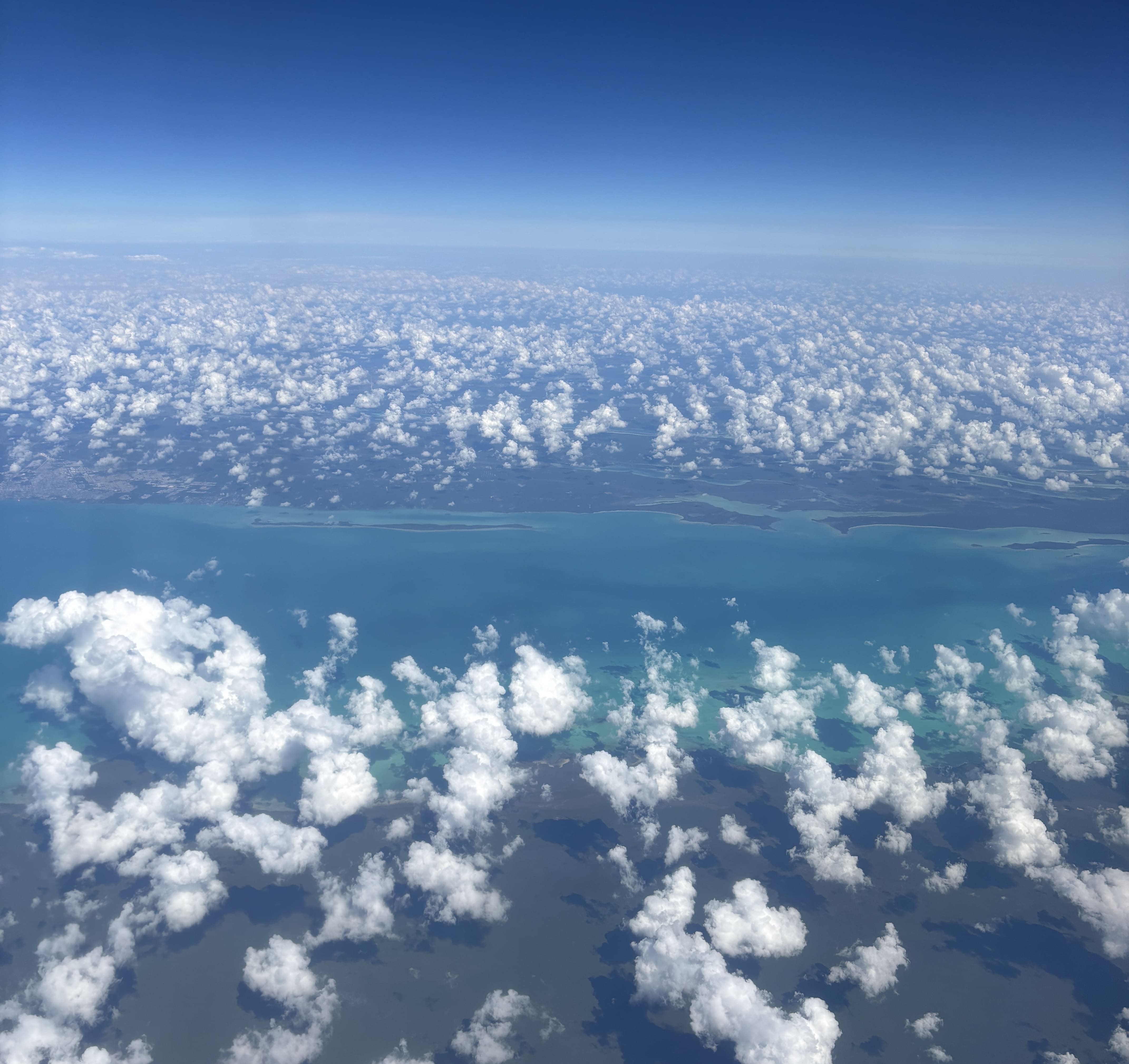
Scenery along my flight from San Salvador.
On that note, I do credit the business class flight attendant for dealing with an extra burden: the curtain separating the business and economy cabins was missing on our flight (the device that holds it was there, the curtain itself was not; it was present on my Managua to San Salvador flight, so this is still part of Avianca’s business class offering). Despite regular announcements that the forward lavatory was exclusively for business class passengers, crew were diligent at re-directing other passengers with selective hearing to the back of the plane whenever they noticed.
Despite being let down by the lack of dividing curtain, crew on this flight did as good a job as could be expected of enforcing the coach/business class divide.
Likewise an announcement was made after landing that deplaning was to begin with business class, though this was not enforced (and in fairness, there was no realistic way for crew to get back to the divide once the seatbelt sign was switched off). I was impressed on my first Managua-San Salvador flight that a crew member did move back to stand where the curtain would be until business class passengers had departed, though in that case there were only three of us to pass by, and I was the only one with a cabin bag.
Cost and Value
I paid $450.83 US to fly MGA-SAL-YYZ. This fare included two checked bags, a carry-on, and a personal item, as well as seat selection and full refundability. Avianca business class earns 125% of distance flown with Air Canada’s Aeroplan program, netting me just shy of 3,000 miles一the value of which exceeded the $150 or so difference between basic economy and business class when I booked.
You shouldn't book Avianca regional business class as an indulgence, but as a means of comfortable travel, it's perfectly fine.
Considering Avianca’s low-cost approach to economy, its business class tickets are often competitively priced: if you want a bag and seat selection, you’re often not far off the cost difference. Avianca also routinely offers cheap upgrades (the woman seated next to me shared that she had purchased an upgrade, though it would have been uncouth to ask how much she had paid), however these come with the baggage restrictions and mileage earnings of your original fare class.
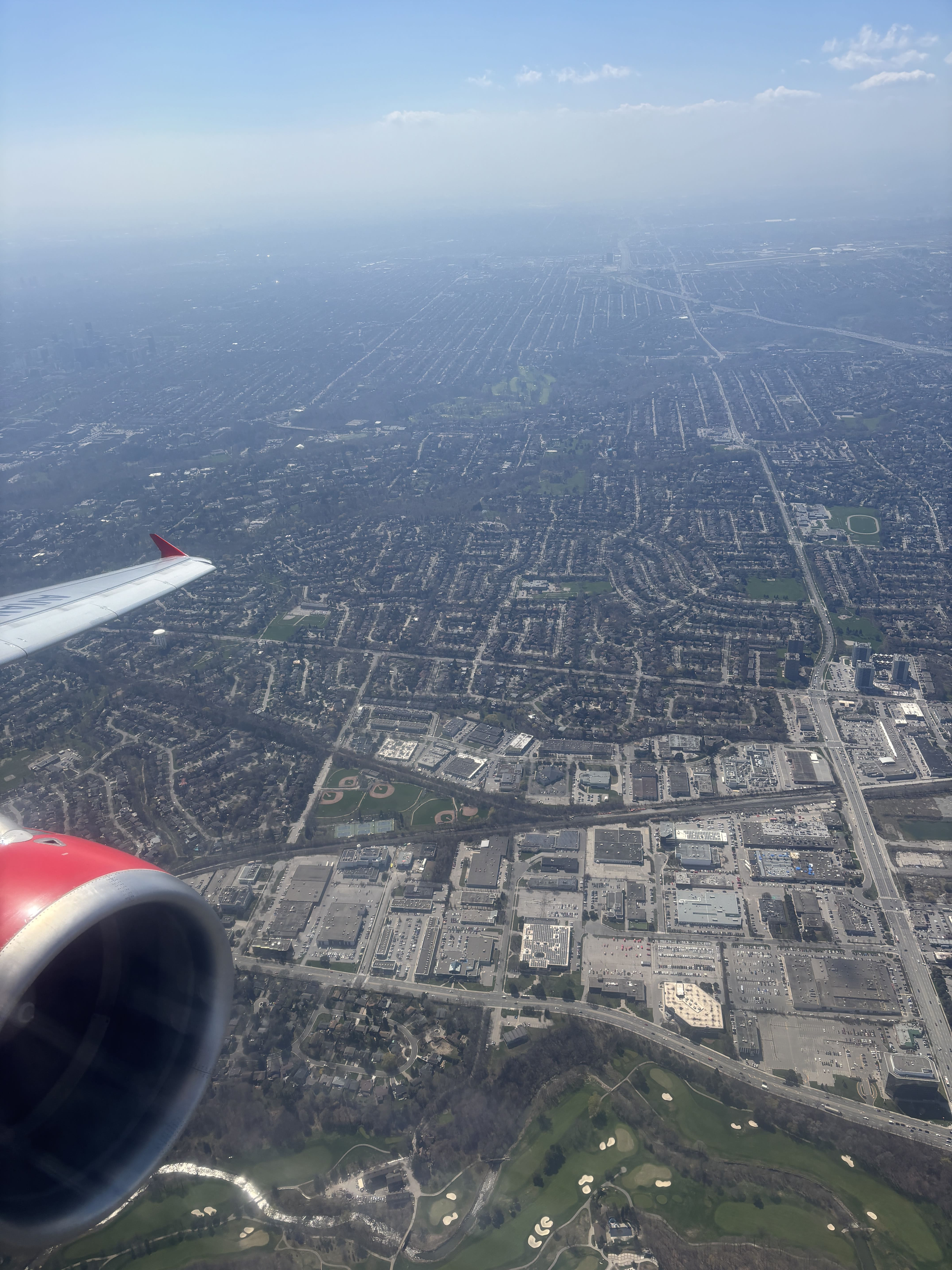
Much less scenic views as we descend into Toronto.
Managua is, after Belmopan, the least-connected capital in Central America. Being able to get back to Toronto with only a single short connection, for around $200 less than American (hardly the last word in luxury travel) was charging to go with a longer stop in Miami, demonstrates the main value proposition of Avianca: they routinely offer cheap, convenient business class tickets.
That being said, you’d have to be insane to book this with points or to buy their higher-priced tickets.
Final Thoughts
I didn’t hate Avianca business class. I didn’t hate my previous flights with them, either. The carrier seems to attract overly-dramatic criticism: it’s more comfortable than economy, and often priced around the same as economy on direct flights with North American carriers. True the lounge wasn’t great (the ones in Bogotá are much better), the food was bad, and the seat is sub-optimal, but you still get more space than similarly-priced alternatives, plus generous baggage allowance and mileage earning.
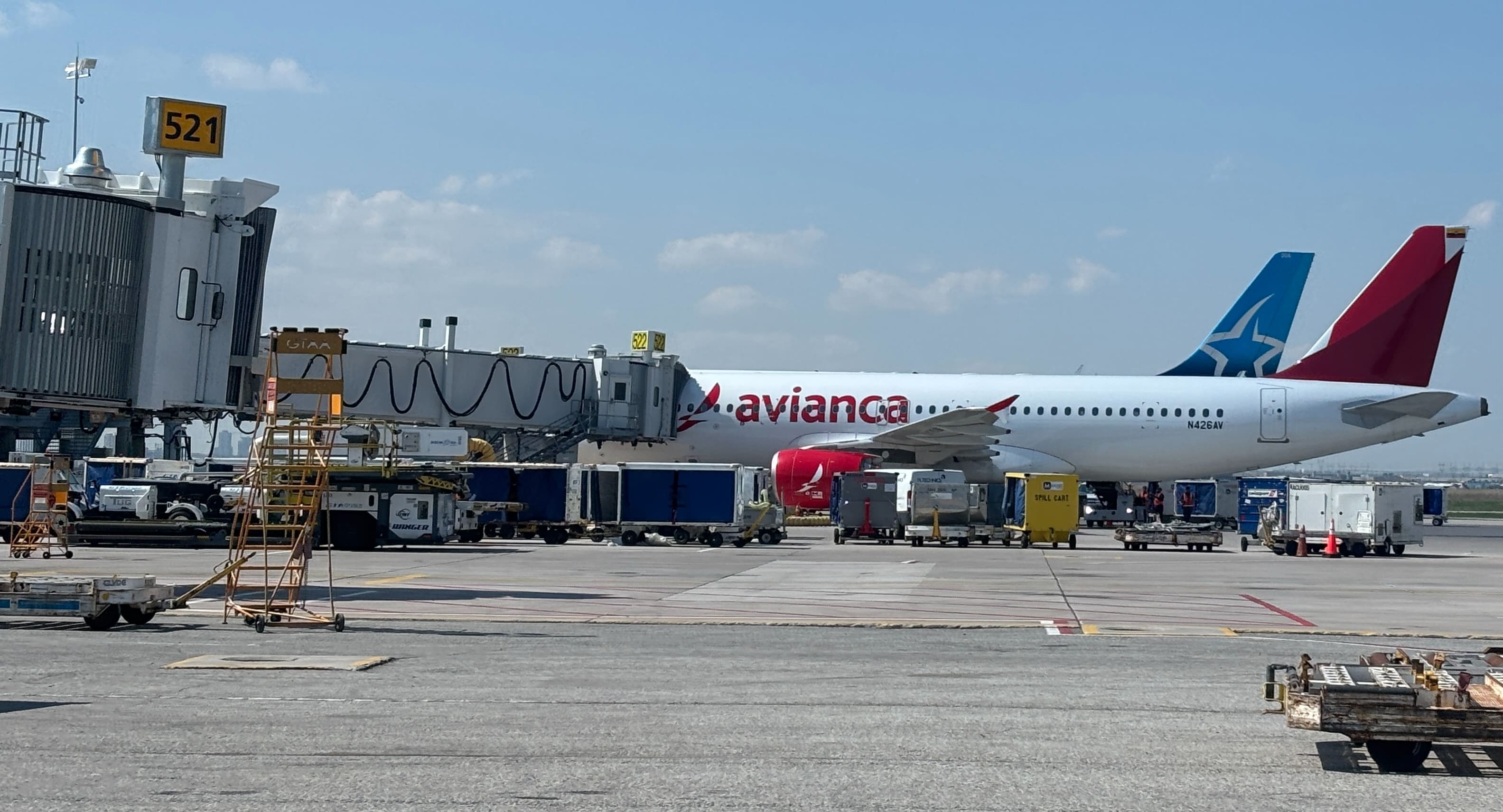
After landing in Toronto, we passed our sister plane, an A320neo of Avianca Colombia.
You won’t look forward to flying in business class on an Avianca A320. But you won’t dread it, either…the same can’t be said for flying most economy products nowadays. It serves a job, at a fair price. For that price, I’d not hesitate to fly with the carrier again (and indeed will do later this year).